
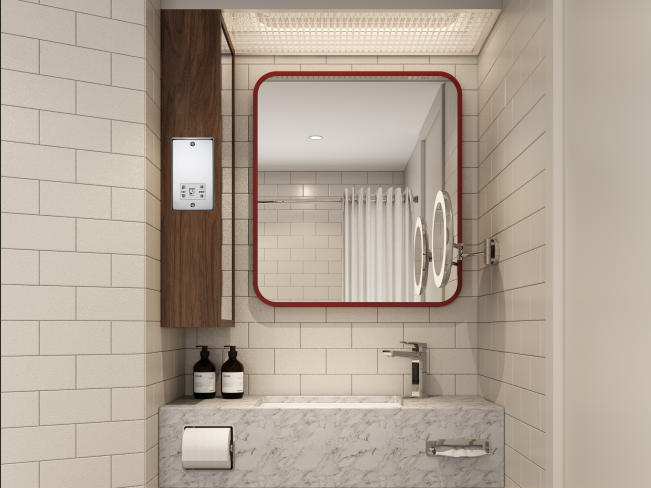
Introduction: Designing for a Cabin That Never Stands Still
Cruise ship cabins are compact, enclosed spaces that operate in conditions unlike any land-based environment. Movement, vibration, and limited natural light shape how passengers experience both the bedroom and bathroom throughout the day and night.
Guests interact with mirrors repeatedly, from early-morning preparation to evening routines and night-time movement. In cabins where space is restricted and lighting conditions change constantly, mirrors take on a role that goes far beyond reflection, supporting comfort, orientation, and visual stability.
Lighting decisions around cabin mirrors directly influence safety, ease of use, and the perceived quality of the accommodation. When specified correctly, LED mirrors create clarity and calm in both bedroom and bathroom zones. When specified poorly, they introduce glare, inconsistency, and operational issues that quickly undermine the passenger experience.
The Cabin Reality: What Passengers Experience Inside Cruise Ship Cabins
Cruise ship cabins are compact environments where every element is experienced at close range. In both the bedroom and bathroom, passengers interact with mirrors within tight sightlines, often standing directly in front of them, making lighting quality and visual balance immediately apparent.
Many interior cabins operate without natural daylight. As a result, mirrors in both zones rely entirely on artificial lighting to provide clarity for grooming, dressing, and orientation. In bedrooms, mirrors often support dressing and preparation, while in bathrooms they serve more intensive grooming functions. In both cases, lighting accuracy matters more than intensity.
Movement and vibration are constant factors at sea. Even subtle motion can amplify glare, uneven illumination, or flicker, making poorly engineered lighting feel uncomfortable. In bathrooms, this is combined with high humidity and rapid condensation after showers. In bedrooms, changing light conditions from daytime to night-time create additional demands on lighting behaviour.
Because of these conditions, cabin mirrors must compensate for what the space lacks. They are required to provide stable illumination, visual calm, and dependable performance across both bedroom and bathroom environments, regardless of time of day or sea conditions.
Lighting That Works When the Ship Moves
At sea, lighting imperfections are amplified. Uneven illumination that might go unnoticed on land becomes immediately apparent when the environment is in motion. In compact cabins, where passengers are close to the mirror, inconsistent light distribution can feel distracting or uncomfortable.
Glare and hotspots are particularly problematic. Reflections shift subtly with movement, making harsh highlights feel more intense and visually fatiguing. What appears acceptable in a static showroom often feels intrusive once installed onboard.
Flicker-free performance is equally critical. Cruise ships experience variations in power supply as systems operate across different loads. Lighting must remain stable under these conditions, without visible flicker or colour fluctuation.
In a moving cabin, successful lighting feels calm and predictable. It supports the passenger without reacting to every change in motion or power, reinforcing a sense of comfort and control rather than drawing attention to itself.
Moisture, Steam, and Salt: The Hidden Enemies Inside Cabins
Cruise ship cabins operate in an environment where moisture is constant rather than occasional. Bathrooms generate steam multiple times a day, and in compact cabins that moisture disperses quickly into surrounding spaces. Over time, this creates sustained humidity levels that place continuous stress on electrical components and finishes.
Salt air adds another layer of complexity. Even in interior cabins, microscopic salt particles migrate through ventilation systems and settle on internal components. This process is slow and invisible, but it accelerates corrosion if materials and construction methods are not specifically designed for marine conditions.
Because of this combination, internal corrosion can occur even in areas that appear dry and well-protected. LED modules, wiring connections, and drivers are particularly vulnerable when sealing is inadequate or inconsistent.
Sealed construction is therefore not a design preference but a functional requirement. Properly protected internal assemblies prevent moisture ingress, reduce corrosion risk, and ensure stable lighting performance over the long term. In a cruise environment, durability is defined by how well a mirror withstands these hidden conditions, not just how it performs on day one.
Why Cabin Mirrors Must Be Quiet and Stable
Cruise ship cabins are quiet, enclosed environments where passengers are close to every surface. In these conditions, even minor electrical noise from lighting components can become noticeable. A faint hum or buzz that might be ignored in a larger space is amplified in a compact cabin and quickly undermines the sense of calm.
Flicker is also perceived more easily at close range. When a passenger is standing directly in front of a mirror, any instability in light output becomes immediately apparent, especially under changing power loads common in marine electrical systems. What seems acceptable in a static setting can feel uncomfortable once the ship is in motion.
Silence and stability are therefore key indicators of quality. Smooth, flicker-free lighting and quiet electrical operation contribute to a feeling of reassurance and refinement, even if the passenger cannot identify the technical cause. In cruise cabins, perceived luxury is often defined by what guests do not notice rather than what they do.
Consistency Across Hundreds or Thousands of Cabins
Cruise brands rely on consistency to protect their identity and passenger expectations. Regardless of cabin category or deck location, guests expect the same lighting quality, colour tone, and visual comfort throughout the ship. Even small variations become noticeable when passengers move between cabins or across different vessels within a fleet.
Variation often occurs when suppliers change between build phases or when specifications are interpreted differently over time. Inconsistent output, colour temperature, or construction detail creates visual mismatch and complicates quality control.
Repeatable mirror systems simplify maintenance at sea. When lighting performance, components, and mounting methods are standardised, crew can service and replace parts efficiently without carrying multiple spares or dealing with unpredictable failures.
In a marine context, luxury is defined by reliability at scale. A mirror that performs flawlessly in one cabin but inconsistently across hundreds does not meet cruise industry expectations.
Installation in a Shipbuilding Environment
Cruise ship cabins are assembled under strict sequencing and space constraints. Mirrors must integrate seamlessly with prefabricated cabin modules, where electrical and wall systems are completed long before final finishes are visible.
Hardwired electrical coordination is essential. Cable routing, fixing points, and connection access must be planned in advance to avoid rework or compromised safety standards during installation.
Maintenance access is equally critical. Mirrors must be installable and serviceable without requiring wall dismantling or disruption to surrounding finishes. Designs that ignore this reality create long-term operational challenges.
For these reasons, mirrors used in cruise cabins must be designed with shipbuilding processes in mind from the outset. Products adapted from land-based applications rarely align with marine installation requirements and often introduce avoidable risk.
Smart Features That Make Sense at Sea
In cruise ship cabins, smart features must deliver clear functional value without adding complexity. Bathrooms experience rapid humidity changes, making demisters essential for maintaining visibility and preventing condensation build-up after showers.
Motion-activated lighting supports night-time safety, allowing passengers to move comfortably without sudden brightness or disruption. When implemented correctly, it improves usability without requiring manual control.
However, over-complex features introduce unnecessary risk. Additional sensors, interfaces, or connectivity can increase points of failure in a marine environment where access for repair is limited. At sea, smart technology must be robust, intuitive, and purpose-driven.
In this context, smart should mean resilient and dependable, not elaborate.
Why Cruise Ship LED Mirrors Cannot Be “Hotel Mirrors at Sea”
Although cruise cabins share visual similarities with hotel rooms, the conditions they operate in are fundamentally different. Constant movement, higher humidity, salt exposure, and stricter inspection requirements place demands on mirrors that land-based products are not designed to meet.
Assumptions made for hotels often fail onboard. Electrical systems behave differently, maintenance access is more restricted, and performance expectations are higher over longer operating cycles. Mirrors that perform well on land can degrade quickly when exposed to marine conditions.
For this reason, shipyards and marine fit-out companies require LED mirrors that are engineered specifically for cruise ship use. Purpose-designed construction, tested components, and repeatable production are essential. This distinction is what separates marine-grade solutions from adapted hospitality products and defines Luma’s expertise in cruise ship cabin environments.
Why Shipyards and Marine Fit-Out Companies Work With Luma Mirrors by Gemm London
Luma Mirrors by Gemm London focuses exclusively on cruise ship guest bedrooms and bathrooms, allowing every design and engineering decision to be shaped by real passenger use and marine conditions. This specialisation ensures mirrors are not adapted from land-based products but developed specifically for cruise ship environments.
With experience coordinating directly with shipyards and marine interior teams, Luma Mirrors understands the sequencing, compliance, and documentation requirements of shipbuilding projects. LED mirrors are engineered to perform reliably under movement, high humidity, and long operating cycles, while maintaining visual consistency across large cabin programmes.
Design, engineering, manufacture, and installation coordination are treated as a single system. This integrated approach reduces interface risk, improves repeatability, and supports smoother inspections and handover.
Contact Our Marine Projects Team
Luma Mirrors works in close collaboration with shipyards and marine fit-out companies from the earliest project stages. Early technical alignment helps minimise rework, reduce inspection risk, and ensure mirrors integrate smoothly into prefabricated cabin systems.
If you are planning a cruise ship project and require LED mirror solutions engineered specifically for cabin environments, our marine projects team is ready to support you with bespoke designs, technical coordination, and long-term performance in mind.
