
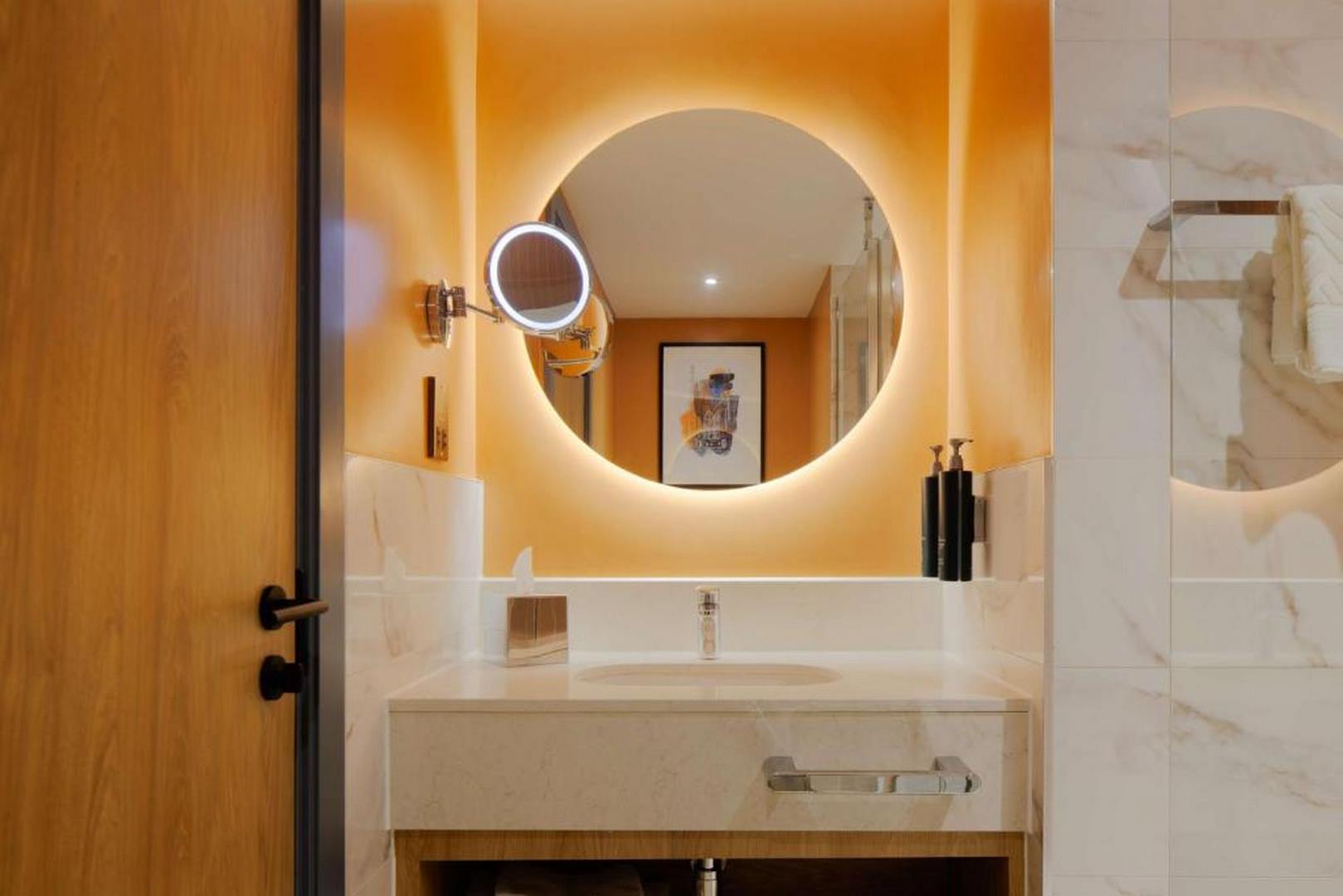
Luxury in a hotel bathroom is often judged in the moments guests spend in front of the vanity. This is where lighting, reflection, and proportion converge, and where small design decisions have an outsized impact on comfort, confidence, and overall perception of quality. A vanity LED mirror is not just a decorative feature. It is a functional lighting element, an electrical installation, and a key part of the guest’s daily routine.
In hospitality environments, mirrors are used far more intensively than in residential settings. They must perform reliably under constant use, high humidity, frequent cleaning, and varying electrical conditions, while still delivering a calm, refined visual experience. When vanity mirrors are specified without sufficient consideration for lighting quality, proportion, durability, and integration, the result is often discomfort, maintenance issues, and a space that feels less considered than intended.
This guide explores the principles that define truly luxurious hotel vanity LED mirrors. It focuses on practical, experience-led considerations rather than trends or feature lists, helping designers, specifiers, and contractors understand what genuinely elevates the guest experience and what simply adds complexity. By examining lighting behaviour, construction quality, operational realities, and long-term performance, the article provides a clear framework for specifying vanity mirrors that support both design intent and hospitality standards.
1. Start With Lighting Quality, Not Brightness
In luxury hotels, the quality of light matters far more than raw brightness. Guests don’t judge mirrors by lumen output — they judge them by how they feel when standing in front of them.
What to specify:
- CRI 90 or higher to ensure accurate skin tones and true material colours
- Even, face-level illumination that avoids harsh shadows
- High-quality diffusion with no hotspots, glare, or uneven light spill
Why this feels luxurious:
Guests feel naturally comfortable and confident at the vanity. The lighting looks effortless and flattering, even though they may not consciously recognise the technical reason behind it.
2. Use Integrated Lighting Intentionally
Luxury vanity mirrors are designed with clear lighting intent. They do not rely on a single lighting method to solve every requirement.
Best practice:
- Front-lit or edge-lit illumination for accurate, face-level grooming
- Backlighting used as ambient framing, contributing softness and depth rather than functional task light
- Avoid relying on backlighting alone at the vanity, where it rarely provides sufficient facial illumination
Luxury signal:
The lighting feels natural and balanced, never theatrical or forced. Guests experience clarity where it’s needed and ambience where it’s appropriate, without noticing the mechanics behind it.
3. Choose the Right Colour Temperature for the Space
Luxury lighting always feels deliberate. It supports the materials and atmosphere of the room rather than drawing attention to itself.
Typical hotel approach:
- Warm to neutral light that complements stone, timber, and soft-toned finishes
- Consistent colour temperature across all rooms to maintain a unified visual identity
Why it matters:
Lighting that is too cool or inconsistent instantly feels commercial rather than considered. Guests may not articulate the issue, but they sense when the space lacks warmth and cohesion.
4. Get Proportion Perfect
In luxury environments, proportion often matters more than the materials themselves.
Key rules:
- Mirror width aligned with the vanity, not floating arbitrarily on the wall
- Height designed to suit a wide range of guest heights, not a single ideal user
- Slim profiles and clean edges that integrate seamlessly with the architecture
Luxury signal:
The mirror looks architecturally intentional, as if it was designed as part of the room rather than added later.
5. Use Materials That Age Well
Luxury hotels specify materials that maintain their appearance through years of use, cleaning, and environmental exposure.
What works:
- Low-iron glass for clear, accurate reflection
- Moisture-resistant frames or frameless constructions suitable for bathroom conditions
- Finishes that complement marble, stone, and timber rather than competing with them
Luxury is not trend-driven. It is defined by materials and details that continue to feel refined long after opening day.
6. Eliminate Disruptions to the Guest Experience
Luxury disappears the moment something feels inconvenient or unreliable.
Must-have features:
- Demister functionality to ensure immediate clarity after showers
- Clean, uncluttered surfaces with no visible switches or distracting controls
- Optional motion-activated night lighting for ease of use without disturbance
Luxury feeling:
Everything responds exactly when the guest expects it to, without explanation or adjustment.
7. Ensure Consistency Across All Rooms
Luxury hotels are remembered for cohesion, not individual statement pieces.
What professionals prioritise:
- Uniform lighting output, CRI, and colour temperature across all guest rooms
- Consistent mirror proportions between room categories and layouts
- Controlled batch production to avoid variation over time
Why this matters:
Luxury at scale depends on reliability and repetition. Inconsistency undermines brand confidence.
8. Design for Silence and Stability
Luxury spaces feel calm, both visually and technically.
Technical requirements:
- Flicker-free LED drivers with stable performance
- Consistent colour output that does not shift over time
- Effective heat management within the mirror assembly
Guests may never see these details, but they immediately sense when something feels unsettled or cheap.
9. Integrate Safety Invisibly
True luxury never looks technical, even when it is highly regulated.
Essential standards:
- IP44 or higher protection for bathroom environments
- Fully sealed internal construction
- Professional hardwired installation suited to hospitality use
Compliance should be present, documented, and invisible to the guest.
10. Work With a Hospitality-Focused Manufacturer
Luxury outcomes are shaped by experience, not product catalogues.
The right partner:
- Designs mirrors specifically for guest bathrooms, not general retail use
- Understands lighting performance, electrical safety, and durability as one system
- Provides CAD coordination, mock-ups, installation support, and long-term service
Luxury is engineered through knowledge, testing, and consistency, not styling alone.
11. Acoustic and Electrical Quietness
Luxury is not only visual. It is sensory.
What matters:
- Silent LED drivers with no hum, buzz, or electrical noise
- Stable electrical performance without flicker during voltage fluctuation
Why it matters:
Guest bathrooms are quiet environments. Even minor electrical noise or instability disrupts the sense of calm and instantly erodes perceived quality.
12. Create a Seamless Day-to-Night Experience
Luxury hotels design for continuous use, not just daytime presentation.
Good practice:
- Subtle low-level illumination through the mirror for night-time use
- Optional motion activation that responds gently without sudden brightness
Luxury signal:
Guests can move comfortably at night without glare, shock, or disruption to rest.
13. Design for Cleaning and Housekeeping Reality
Luxury hotels always consider long-term operations.
Design considerations:
- Flush surfaces with no ledges that collect dust or moisture
- No exposed seams or fragile detailing
- Resistance to frequent chemical cleaning used by housekeeping teams
Why it matters:
A mirror that deteriorates visually after a short period will never feel luxurious again, regardless of how well it looked on opening day.
14. Build Tolerance for Human Error
Luxury hospitality designs for reality, not ideal conditions.
Key expectations:
- Electrical tolerance to inconsistent power supply
- Moisture resistance beyond minimum exposure scenarios
- Robust mounting systems that remain aligned over time
Luxury is resilience that performs quietly, without looking over-engineered.
15. Align With Brand Identity, Not Decoration
Luxury mirrors support the hotel’s narrative. They never compete with it.
How this shows:
- Lighting tone aligned with the brand’s mood and positioning
- Consistent shapes and finishes repeated across room categories
- No unnecessary features that distract or age quickly
Luxury communicates confidence through restraint.
16. Future-Proof the Design
Luxury hotels think well beyond opening day.
Smart choices include:
- Modular LED components where feasible
- Replaceable drivers without damaging walls or finishes
- Standardised specifications that support future renovations or expansions
Why it matters:
Luxury that ages gracefully is remembered. Luxury that fails early is not.
17. Validate Design Through Human-Centred Testing
The best luxury mirrors are tested in context, not assumed to work.
What leading projects do:
- Mock-ups installed at real vanity heights
- Lighting tested against actual materials and finishes
- Face-level evaluation, not showroom-distance viewing
Luxury is proven through performance, not theory.
Conclusion: Luxury at the Vanity Is Designed, Not Added
Luxury in hotel vanity LED mirrors is never the result of a single feature or a bold design gesture. It is built through a series of deliberate, often invisible decisions that prioritise how guests actually use the space, how lighting behaves at face level, and how the mirror performs over years of daily operation.
The seventeen principles above reveal a consistent truth. True luxury comes from lighting quality rather than brightness, proportion rather than decoration, and reliability rather than novelty. It is felt in silent operation, stable colour, effortless usability, and the confidence that everything simply works as expected. When these elements are missing, even the most visually striking mirror quickly feels ordinary.
For hotels, cruise ships, and large residential developments, luxury is also about consistency. Guests remember spaces that feel cohesive, calm, and dependable across every room. Vanity mirrors play a central role in delivering that experience because they sit at the intersection of lighting, design, comfort, and electrical safety.
When specified correctly, a vanity LED mirror does not draw attention to itself. It supports the architecture, enhances the guest’s daily rituals, and quietly reinforces the brand’s standard of quality.
From Concept to Installation, Let’s Get It Right
If you are designing or specifying vanity LED mirrors for a hospitality project, early collaboration makes the difference between a mirror that simply looks good and one that performs flawlessly in real-world use.
Luma Mirrors by Gemm London works exclusively with guest bathrooms and bedrooms, supporting designers, specifiers, contractors, shipyards, and FF&E teams from concept through installation. Our approach combines lighting engineering, bespoke design, hospitality-grade manufacturing, and on-site expertise to deliver vanity mirrors built for long-term performance.
Contact our team to discuss your project requirements and explore bespoke hotel vanity LED mirror solutions designed specifically for luxury hospitality environments.
