
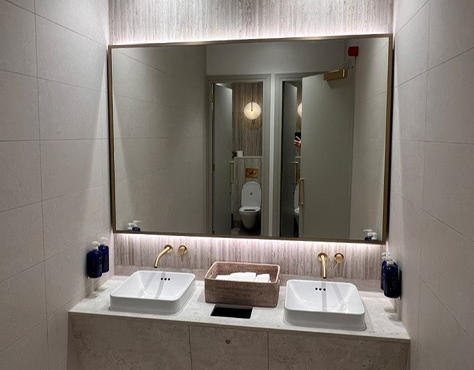
Introduction: Why Guest Bathroom LED Mirrors Are a High-Impact Decision
In hotel guest bathrooms, mirrors play a far greater role in guest comfort than many larger or more expensive fixtures. Guests interact with the mirror at close range and for extended periods, making it one of the most scrutinised elements in the room. When lighting, reflection, or proportion feels wrong, the discomfort is immediate and difficult to ignore.
LED mirrors sit at the intersection of lighting design, electrical safety, and interior architecture. They are not standalone accessories but integrated systems that must perform reliably in humid environments while delivering accurate, comfortable illumination. Because of this complexity, errors in mirror selection often have wider consequences than anticipated.
Poor mirror specification can create disproportionate operational problems. Issues such as uneven lighting, premature component failure, moisture ingress, or non-compliant installation frequently lead to guest complaints, increased maintenance, and costly replacements that disrupt occupied rooms.
This guide is designed to help professionals make informed decisions, not just compare features. It focuses on how to evaluate guest bathroom LED mirrors from a performance, safety, and long-term reliability perspective, supporting confident specification in real hospitality environments.
Step One: Confirm the Mirror Is Designed for Guest Bathroom Use
Not all LED mirrors are suitable for hotel guest bathrooms, even if they appear visually similar. Many products on the market are designed for residential use, where humidity levels, usage frequency, and cleaning routines are far less demanding.
Guest bathrooms require mirrors that can withstand daily steam exposure, frequent cleaning, and continuous operation without degradation. Hospitality-grade mirrors are engineered with higher protection standards, more durable materials, and components selected for long service life.
Before evaluating design or features, professionals should first confirm that the mirror is purpose-built for guest bathroom environments. This single check eliminates a large proportion of products that may look acceptable on paper but fail under real hospitality conditions.
Step Two: Understand How Guests Actually Use Bathroom Mirrors
Guests interact with bathroom mirrors at very close range, typically standing directly in front of the vanity at face level. Unlike general bathroom lighting, mirror lighting is experienced from a fixed position, making any imbalance, glare, or colour distortion immediately noticeable.
Most grooming activities such as shaving, skincare, makeup, or contact lens use require accurate, even illumination across the face. Lighting that is too directional, uneven, or colour-shifted creates shadows and visual fatigue, reducing comfort even in otherwise well-designed bathrooms.
Mirrors also play a critical role in how clean and well-maintained a bathroom feels. Clear reflections, consistent lighting, and accurate colour rendering enhance the perception of hygiene and quality, while poor lighting exaggerates imperfections and undermines the guest experience.
Understanding these real usage behaviours allows designers and specifiers to prioritise lighting performance and positioning over purely decorative considerations.
Step Three: Define the Role of the LED Mirror in the Lighting Scheme
Before selecting an LED mirror, it is essential to define what role the mirror is expected to play within the overall lighting strategy. In some projects, the mirror is designed to replace traditional vanity lighting, while in others it is intended to support ceiling or wall-mounted luminaires. Confusing these roles often leads to poor performance.
Integrated mirror lighting can serve three distinct functions: task lighting for grooming, ambient contribution to soften the space, and visual framing that enhances the vanity area architecturally. Problems arise when these functions are blurred. Backlit mirrors, for example, are frequently misused as primary task lighting despite being better suited to ambient or framing purposes.
Clearly defining the mirror’s intent at the specification stage prevents both over-specification, which increases cost and complexity without benefit, and under-specification, which results in insufficient illumination and guest dissatisfaction. A well-defined role ensures the mirror complements the lighting scheme rather than compensating for its shortcomings.
Step Four: Evaluate Lighting Quality, Not Feature Lists
Light Distribution and Diffusion
Lighting quality at the mirror is defined by how evenly light is delivered across the face, not by how bright the LEDs appear on a specification sheet. Uniform illumination avoids harsh shadows, eye strain, and visual discomfort. Poor diffusion, by contrast, creates hotspots, glare, and uneven light falloff, all of which are immediately noticeable to guests at close range and quickly undermine the perception of quality.
Colour Rendering and Visual Accuracy
In hospitality environments, a Colour Rendering Index of ninety or higher is widely expected for bathroom mirrors. High CRI lighting ensures accurate skin tones and faithful representation of materials such as marble, stone, timber, and metal finishes. Lower CRI lighting can make skin appear dull or unnatural and distort surface colours, even when overall brightness seems adequate.
Colour Temperature Consistency
Selecting warm, neutral, or cool light should be driven by the interior palette and brand intent, not personal preference. Equally important is maintaining consistent colour temperature across all guest rooms. Variations between rooms are easily perceived by repeat guests and operators, weakening brand standards and creating avoidable dissatisfaction. Consistency, not novelty, defines professional hospitality lighting.
Step Five: Decide When Integrated Lighting Works Alone and When It Does Not
Integrated LED lighting can perform exceptionally well at the vanity, but only when the surrounding conditions are suitable. In compact guest bathrooms with controlled ambient lighting, light-coloured finishes, and single-basin layouts, a well-engineered LED mirror can provide sufficient task support while maintaining a clean, uncluttered aesthetic.
In larger bathrooms, double-basin vanities, or spaces finished with dark stone or light-absorbing materials, additional lighting becomes unavoidable. In these environments, relying solely on the mirror often leads to uneven illumination, facial shadowing, or insufficient light at the edges of the vanity zone.
Over-reliance on the mirror as the only light source is a common specification error. Mirrors are best used as a precision lighting element, not a universal solution. Layered lighting—combining integrated mirror light with ceiling, wall, or accent fixtures—improves reliability, visual comfort, and consistency across varied room types while reducing performance risk in high-use hospitality settings.
Step Six: Safety, IP Ratings, and Long-Term Reliability
Guest bathroom mirrors are exposed to moisture even when they sit outside formal wet zones. Steam, condensation, frequent cleaning, and limited ventilation all introduce long-term moisture stress that must be accounted for at specification stage. Treating vanity mirrors as “dry-area products” is one of the most common causes of premature failure in hospitality bathrooms.
IP ratings must apply to the entire mirror assembly, not just the LED strip or driver. Sealed lighting components, protected wiring, moisture-resistant backing, and correctly sealed cable entries all contribute to real-world IP performance. In hospitality environments, IP44 is widely regarded as the minimum acceptable standard, providing protection against splashing water and airborne moisture while maintaining design flexibility.
Installation decisions directly affect long-term safety and reliability. Poor sealing, incorrect wall preparation, or compromised cable routing can negate the mirror’s IP rating entirely. For hotels and cruise ships, electrical safety and durability are achieved not through product selection alone, but through the combined performance of design, specification, and installation quality over time.
Step Seven: Construction Quality and Hidden Engineering
Construction quality determines whether a guest bathroom LED mirror performs consistently over years or becomes a maintenance issue within months. One of the most critical differences lies in the diffusion system. High-quality mirrors use engineered diffusion layers to spread light evenly across the surface, while exposed or poorly shielded LED channels create hotspots, glare, and uneven illumination that immediately undermine perceived quality.
Heat management is another invisible but decisive factor. In sealed mirror systems, LEDs and drivers generate heat that must be dissipated correctly. Poor thermal design accelerates LED degradation, causes colour shift, and increases the risk of driver failure. Well-engineered mirrors balance sealing for moisture protection with controlled heat dissipation to maintain stable output over time.
When engineering is compromised, common symptoms appear quickly. Flicker, inconsistent brightness, premature LED failure, and electrical faults are often the result of inadequate drivers, poor wiring layouts, or insufficient thermal control. These issues are especially disruptive in hotels, where room downtime directly impacts operations and revenue.
Build quality also affects maintenance cycles. Mirrors designed for hospitality use allow predictable performance, longer service intervals, and easier access when servicing is required. In contrast, poorly engineered products increase callouts, replacement costs, and operational disruption. For commercial and hospitality projects, hidden engineering quality is as important as visible design.
Step Eight: Proportion and Repeatability Across Guest Rooms
Proportion is one of the most visible indicators of quality in a guest bathroom. Errors in mirror width, height, or placement are noticed instantly by guests, often more so than material or finish choices. A mirror that feels too narrow for the vanity or visually disconnected from the basin disrupts balance and undermines the overall design intent.
Correct proportion starts with aligning the mirror size to the vanity width and primary sightlines. In hospitality bathrooms, mirrors should visually anchor the vanity rather than appear as an isolated object on the wall. Height must also account for typical guest eye levels, lighting position, and how the mirror interacts with surrounding tiles, taps, and wall finishes.
In hotel projects, repetition consistently outperforms individuality. While unique mirrors may work in private residences, hospitality environments rely on predictability and uniformity. Guests subconsciously associate consistency with quality, professionalism, and brand reliability.
Standardisation across room types supports this consistency. Using controlled dimensions, lighting output, and positioning across all guest rooms ensures a cohesive experience, simplifies installation, reduces specification risk, and protects brand standards at scale.
Step Nine: Smart Features That Add Real Hospitality Value
In hospitality projects, smart features should improve usability, safety, and operational efficiency. Features that exist only to impress on a specification sheet often add cost and long-term risk without delivering real value to guests or operators.
Demisters are no longer a luxury feature in guest bathrooms. In high-turnover environments with frequent showers, steam, and cleaning cycles, fog-free mirrors are an expectation. A properly integrated demister maintains clarity, reinforces perceptions of cleanliness, and reduces guest frustration without requiring user interaction.
Motion sensors add value when applied with restraint. In guest bathrooms, low-level or integrated mirror lighting activated at night improves safety and orientation while minimising disturbance. When linked to time delays or occupancy logic, motion sensors also support energy control in large properties without affecting guest comfort.
Integration with central lighting control systems is increasingly important in hotels and cruise ships. Compatibility with systems such as DALI allows mirrors to align with broader lighting scenes, housekeeping modes, and energy management strategies. This ensures the mirror behaves as part of the room system rather than as an isolated product.
Not all smart features are beneficial. Touch screens, speakers, and complex interfaces often increase failure risk, complicate maintenance, and deliver limited practical benefit in guest bathrooms. In hospitality environments, the most effective technology is discreet, reliable, and intuitive, enhancing the experience without drawing attention to itself.
Step Ten: The Real Cost of Choosing the Wrong LED Mirror
Selecting the wrong LED mirror for guest bathrooms often creates problems that extend far beyond the initial purchase price. In hospitality environments, even small failures become highly visible to guests and operational teams.
Early component failure is one of the most common consequences. Poor LED modules, inadequate heat management, or insufficient moisture protection lead to flicker, dimming, or complete lighting failure. These issues quickly result in guest complaints, negative reviews, and pressure on front-of-house teams to resolve problems that should never occur.
Maintenance disruption is another hidden cost. Accessing failed mirrors often requires isolating power, removing fixings, and in some cases damaging finished walls or tiles. Each repair can take a room out of service, reducing available inventory and increasing operational strain, particularly in high-occupancy hotels or cruise ships.
Replacement becomes especially challenging when mirrors were not specified with consistency or long-term availability in mind. Changes in size, colour temperature, or output between batches make like-for-like replacement difficult, forcing wider refurbishment to maintain visual uniformity.
Cheaper mirrors frequently appear cost-effective at purchase but generate higher lifecycle costs through increased maintenance, shorter service life, and reputational impact. In hospitality projects, investing in correctly specified, hospitality-grade LED mirrors reduces risk, protects brand standards, and delivers better value over the life of the property.
Step Eleven: How to Evaluate LED Mirror Suppliers for Guest Bathrooms
Choosing the right supplier is as critical as choosing the right mirror. In hospitality projects, supplier capability directly affects consistency, compliance, and long-term performance.
A qualified supplier should be able to provide verified test data and technical documentation, including IP ratings, CRI values, electrical certifications, and lighting performance reports. These documents allow designers and specifiers to confirm compliance rather than relying on assumptions or marketing claims.
Experience with hotel guest bathrooms is equally important. Suppliers familiar with hospitality understand high-usage patterns, moisture exposure, brand consistency requirements, and coordination with other trades. This experience reduces the risk of design conflicts, installation issues, and premature failures.
The ability to deliver consistent output at scale is a key differentiator. Hotels and cruise ships require hundreds of mirrors to perform identically in terms of brightness, colour temperature, and light distribution. Suppliers must demonstrate batch control, quality assurance processes, and repeatable manufacturing standards.
Beyond the product itself, strong suppliers offer CAD support, technical coordination, and clear installation guidance. Ongoing aftercare, access to replacement components, and long-term support ensure mirrors remain serviceable throughout the project lifecycle, protecting both operational efficiency and brand standards.
Why Luma Focuses Only on Guest Bathrooms and Bedrooms
Luma’s focus on guest bathrooms and bedrooms is intentional. These are the spaces where lighting accuracy, electrical safety, and visual comfort matter most to the guest experience. By specialising rather than broadening into unrelated product categories, Luma is able to design solutions that perform reliably in real hospitality environments.
Lighting is engineered around how guests actually use mirrors, not around catalogue formats or generic feature sets. This means prioritising face-level illumination, colour accuracy, glare control, and consistency across every room type, rather than chasing trends that look good in isolation but fail in daily use.
Engineering, manufacturing, and installation are treated as one integrated system. This approach allows tighter control over diffusion quality, heat management, IP protection, and electrical integration, reducing failure points that often arise when products are sourced, installed, and serviced by separate parties.
For large hotel and cruise ship programmes, this specialisation ensures consistency, safety, and predictable performance across hundreds of rooms. The result is lower operational risk, fewer maintenance issues, and mirrors that continue to perform as intended long after handover.
Contact Our Team
Luma works closely with designers, specifiers, contractors, shipyards, and FF&E teams to deliver hospitality-grade LED mirror solutions that stand up to real-world use.
Early collaboration helps identify risks, align lighting intent, and resolve technical challenges before they reach site. From concept development and CAD coordination through manufacture, installation, and certification, Luma supports projects at every stage.
If you are planning a guest bathroom or bedroom project and need LED mirror solutions designed specifically for hospitality environments, our team is ready to collaborate.
