
Introduction: Why the Vanity Area Deserves Its Own Lighting Strategy
In a hotel guest bathroom, the vanity area is where lighting is tested most critically. It is the space where guests stand closest to the mirror, evaluate their appearance, and form an immediate judgement about comfort, cleanliness, and quality. Because of this proximity, any imbalance in brightness, shadowing, or colour accuracy becomes far more noticeable than in other parts of the room.
Lighting mistakes at the vanity have a disproportionate impact on the guest experience. Overhead lighting can cast unflattering shadows, side lights may create glare, and poorly positioned fixtures often result in uneven illumination across the face. These issues are not only uncomfortable but subtly undermine the sense of care and precision expected in a well-designed hotel environment.
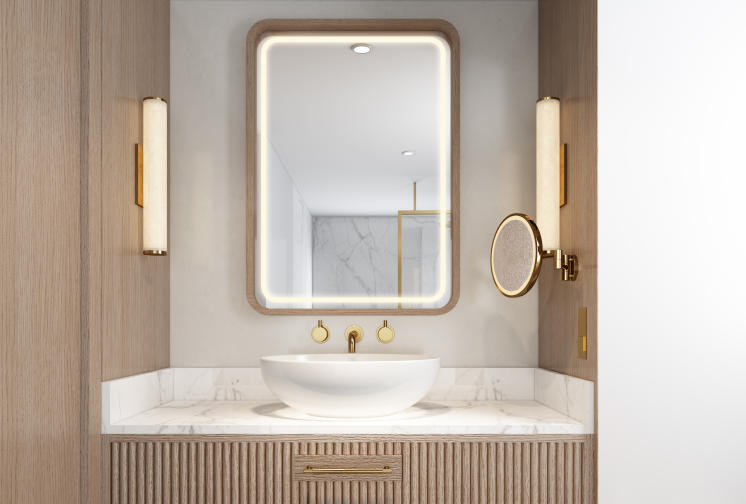
Integrated lighting within the vanity mirror addresses these challenges at the source. By placing light directly around or within the mirror, illumination is delivered exactly where it is needed, with greater control over direction, diffusion, and colour quality. This approach reduces reliance on multiple external fixtures, improves visual comfort, and allows the vanity area to function as a purpose-designed lighting zone rather than an afterthought.
Thinking in Layers: What Integrated Lighting Really Means
Integrated lighting in vanity mirrors is often discussed as a single feature, but in practice it serves multiple, distinct purposes. Treating integrated lighting as one uniform solution can lead to underperformance or misapplication. Understanding how light functions in layers is essential to specifying vanity mirrors that work as intended.
At the vanity, integrated lighting typically contributes in three ways. Ambient contribution refers to the soft illumination that supports the overall brightness of the bathroom without drawing attention to the light source itself. Task support focuses on providing clear, even light at face level for grooming activities. Visual framing uses light to define the mirror’s shape and create a sense of balance within the wall composition.
Design issues often arise when these roles are confused. Backlighting, for example, is frequently specified as the primary light source at the vanity. While it is effective for creating atmosphere and depth, backlighting alone does not provide sufficient forward illumination for grooming. When treated as task lighting, it can result in shadowing and reduced visual clarity.
By approaching integrated lighting as a layered system rather than a single feature, designers can align lighting intent with actual use. This logic-led approach ensures that vanity mirrors deliver the right balance of comfort, functionality, and visual refinement, rather than relying on lighting types as stylistic labels.
The Question Designers Should Ask First: What Is the Mirror Expected to Do?
Before selecting a vanity mirror with integrated lighting, designers should define the mirror’s role within the bathroom lighting scheme. Is the mirror intended to replace traditional vanity lights, or is it designed to support them as part of a layered approach? This distinction has a direct impact on lighting performance, mirror design, and technical specification.
Lighting at the mirror can serve different purposes. In some projects, it is primarily functional, providing clear, accurate illumination for grooming. In others, it contributes to mood, supports wayfinding during night-time use, or reinforces brand expression through shape and glow. Attempting to fulfil all these functions without defining priorities often leads to compromise.
Clarifying the mirror’s purpose early prevents both over-specification and underperformance. Overloading a mirror with unnecessary lighting output or features increases cost and complexity without improving usability. Under-specifying lighting, on the other hand, results in poor visibility and guest dissatisfaction. By answering this question at the outset, designers can align lighting logic, performance requirements, and visual intent into a coherent, effective solution.
When Integrated Lighting Needs Support
While integrated lighting can be highly effective at the vanity, it is not a universal solution. In certain bathroom layouts and design scenarios, additional lighting support is necessary to achieve the desired level of comfort and functionality.
Larger vanities and double-basin layouts often extend beyond the effective reach of a single integrated light source. In these cases, relying solely on mirror-integrated lighting can result in uneven illumination across the width of the vanity, particularly at the outer edges. Supplementary lighting helps maintain consistent brightness and usability for multiple users.
Dark stone, matte surfaces, and light-absorbing finishes can significantly reduce reflected light levels. Even well-designed integrated lighting may struggle to provide sufficient forward illumination in these environments. Supporting light sources ensure that the vanity remains practical without increasing glare or overdriving the mirror’s lighting system.
In guest rooms where the mirror also functions as a decorative or architectural feature, lighting may be specified more for visual impact than task performance. In these cases, integrated lighting is best complemented by other light sources to balance aesthetics with usability. Recognising when integrated lighting needs support demonstrates a pragmatic, experience-led approach rather than an overreliance on a single solution.
Lighting Quality Guests Notice Instantly (Even If They Can’t Explain It)
Guests may not understand lighting specifications, but they immediately sense when lighting quality is poor. Uneven illumination, visible hotspots, or harsh transitions around the mirror are often perceived as low quality, even if the overall brightness is high. This subconscious reaction is why inconsistent lighting is frequently associated with budget or poorly executed spaces.
Colour rendering plays a critical role at close range. Low CRI lighting can distort skin tones, exaggerate shadows, or make the reflection feel unnatural. At the vanity, where guests are inches from the mirror, these inaccuracies affect comfort and confidence. High CRI lighting delivers a more truthful reflection, helping guests feel at ease without consciously identifying the reason.
Consistency matters more than raw brightness. Excessively bright mirrors can cause glare and visual fatigue, while inconsistent output across different rooms undermines brand standards. When lighting is even, balanced, and repeatable, it reinforces a sense of care and quality that guests recognise instantly, even if they cannot articulate why the space feels better.
The Hidden Engineering Behind Good Integrated Lighting
The quality of integrated lighting is defined less by what is visible and more by what sits behind the mirror surface. Two mirrors may look similar when switched off, but their performance over time is determined by engineering choices that are rarely obvious at first glance.
Diffusion systems are a key differentiator. Well-engineered vanity mirrors use optical diffusion layers that soften and spread light evenly across the illuminated area. This eliminates visible LED points and harsh light bands. In contrast, exposed or poorly diffused LED channels often create hotspots and uneven brightness, which quickly undermine the perceived quality of the mirror once it is in use.
Heat management is equally critical, particularly in sealed mirror assemblies designed for moisture protection. LEDs generate heat, and without proper thermal control this heat becomes trapped inside the mirror. Effective designs manage heat dissipation without compromising sealing, protecting both LED lifespan and colour stability. Poor heat management accelerates degradation, leading to dimming, colour shift, or component failure.
When engineering is compromised, issues such as flicker, inconsistent output, and early failure become inevitable. These problems may not appear immediately, but they surface over time in high-use hospitality environments. Robust integrated lighting relies on controlled diffusion, stable electrical components, and thoughtful thermal design, ensuring consistent performance long after installation.
Safety and Longevity at the Vanity Zone
Although vanity mirrors are not always installed directly within shower areas, they remain exposed to moisture on a daily basis. Steam from hot water, condensation caused by temperature changes, and frequent cleaning all introduce moisture into the vanity zone. Over time, this exposure can affect electrical components, mirror backing, and fixings if the product is not designed for such conditions.
For this reason, IP ratings must apply to the entire mirror assembly, not just the LED strips. True protection includes sealed LED modules, protected wiring, moisture-resistant backing materials, and properly sealed cable entry points. If any part of the system is inadequately protected, the overall performance and safety of the mirror are compromised.
Installation decisions also play a critical role in long-term reliability. Incorrect sealing, damaged gaskets, poor cable routing, or inadequate wall preparation can negate the mirror’s intended level of protection. Even a well-engineered mirror can fail prematurely if installed without proper coordination between electrical, waterproofing, and mounting requirements.
When safety and longevity are considered together at the vanity zone, the result is a mirror that performs consistently, resists environmental stress, and maintains its appearance and functionality throughout years of hospitality use.
Why Integrated Vanity Mirrors Are About Consistency, Not Impact
In hospitality design, success is measured by repetition rather than individual statements. Hotels prioritise a uniform guest experience across every room, ensuring that lighting, proportions, and performance feel consistent regardless of location or room category. A single striking mirror may impress in isolation, but inconsistency across rooms quickly undermines perceived quality.
Integrated vanity mirrors support this approach by delivering predictable lighting output, controlled colour temperature, and repeatable proportions across large programmes. When specified correctly, they help maintain brand standards across hundreds of guest bathrooms and bedrooms, reinforcing a cohesive visual identity rather than competing for attention.
To achieve this level of consistency, suppliers must be able to control lighting output at scale. This includes managing colour temperature, CRI, diffusion, and component quality across production batches. Without this control, even minor variations become noticeable when rooms are viewed collectively.
Why Luma Mirrors by Gemm London Approaches Vanity Mirrors Differently
Luma Mirrors by Gemm London focuses exclusively on guest bedrooms and bathrooms, allowing every vanity mirror to be designed around real hospitality use rather than generic catalogue options. Lighting is developed to support grooming comfort, visual clarity, and long-term reliability, not just visual impact.
Our approach integrates engineering, CAD design, manufacture, and installation as a single, coordinated system. This ensures that each mirror performs as intended once installed, with consistent lighting quality, verified safety, and repeatable results across large-scale projects.
Contact Our Team
We invite designers, specifiers, contractors, shipyards, and FF&E procurement teams to collaborate with us early in the design and specification process.
Contact Luma Mirrors to develop bespoke hotel vanity mirror solutions with integrated lighting, supported from initial concept through engineering, manufacture, installation, and certification.
