
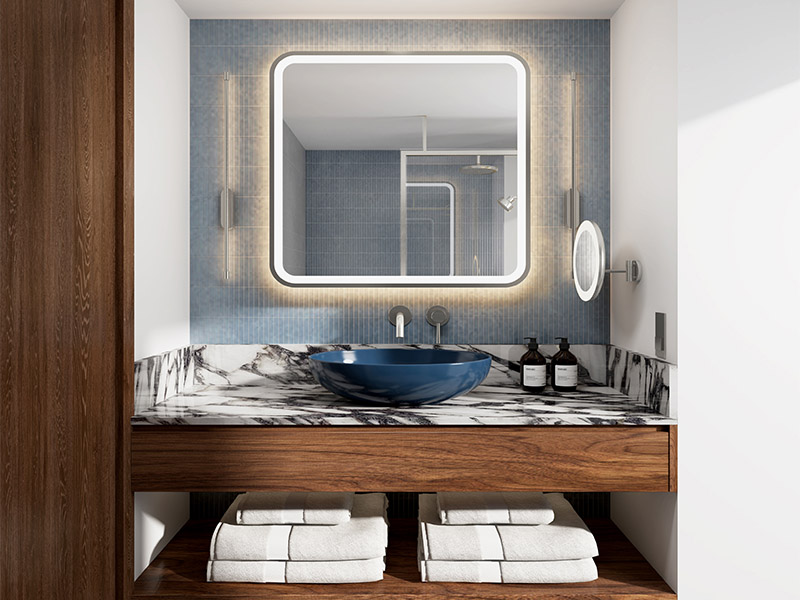
Guest bathrooms in hotels and cruise ships are classified as high-risk electrical environments because water, steam and electricity coexist in close proximity. Unlike many other areas within a property, guest bathrooms are exposed to constant humidity, splashing and temperature changes, all of which increase the likelihood of moisture reaching electrical components. For this reason, lighting and electrical products used in these spaces must meet stricter safety and performance requirements.
In hotels, exposure is intensified by high guest turnover. Showers may be used multiple times a day, often followed by limited ventilation periods. Steam and condensation can build up behind mirrors and within wall cavities, while daily cleaning routines introduce additional moisture through wiping, spraying and contact with wet surfaces. Over time, this repeated exposure can compromise products that are not designed specifically for these conditions.
Residential electrical standards are not sufficient for hospitality use. Products designed for private homes are typically exposed to lower usage levels and less aggressive environmental conditions. In contrast, hotels and cruise ships require components that can operate safely and consistently under continuous use, with minimal tolerance for failure. Using non-hotel-rated mirrors increases the risk of electrical faults, premature deterioration and safety concerns.
An IP44 rating addresses these challenges by providing a defined level of protection against moisture and solid ingress. In real-world hotel guest bathroom conditions, IP44-rated LED mirrors are designed to withstand splashing water, steam and condensation without compromising electrical safety or lighting performance. This makes IP44 the widely accepted minimum standard for LED mirrors installed in guest bathrooms and bedrooms within hotel projects.
In this guide, designers and specifiers will gain a clear understanding of what IP ratings mean, why IP44 is essential in hotel guest bathrooms, where it applies within hotel and cruise ship environments, and how to assess whether an LED mirror genuinely meets the requirements for long-term, safe and reliable use.
What an IP Rating Actually Measures
An IP rating, or Ingress Protection rating, is an international standard used to define how well an electrical product is protected against the intrusion of solid objects and moisture. In hotel projects, IP ratings are a critical reference point because they translate technical protection levels into clear, measurable safety standards.
Understanding the IP Rating System
An IP rating is made up of two numbers. The first number refers to protection against solid objects such as dust or tools. The second number refers to protection against moisture, including splashing water and condensation. The higher the number, the greater the level of protection. For hotel LED mirrors, both aspects are important, as guest bathrooms are exposed to airborne moisture as well as physical contact during cleaning and use.
Solid Protection vs Moisture Protection
Solid protection relates to how well the product prevents foreign objects from entering the enclosure and reaching electrical components. Moisture protection relates to resistance against water ingress from splashing, steam or condensation. In hotel guest bathrooms, moisture protection is typically the more critical factor, as even small amounts of water entering the mirror assembly can lead to electrical faults or long-term deterioration.
Why IP Ratings Apply to the Entire Mirror Assembly
A common misconception is that an IP rating only applies to the LED light source. In reality, the rating covers the entire mirror assembly, including wiring, drivers, connectors and internal components. If any part of the mirror is not adequately sealed, the overall IP rating is compromised. For this reason, true IP44 performance depends on the design and construction of the full mirror system, not just the lighting elements.
Common Misunderstandings About IP Labels
One frequent misunderstanding is assuming that all illuminated mirrors are automatically IP rated. Another is believing that a higher IP rating always means better suitability, regardless of application. In practice, an IP rating must be appropriate to the environment in which the mirror is installed. For hotel guest bathrooms, IP44 is widely accepted as the minimum standard, offering a balance between safety, durability and design flexibility. Understanding what an IP rating actually measures helps designers and specifiers avoid relying on labels alone and instead focus on verified performance and suitability for hospitality use.
What IP44 Means for Hotel LED Mirrors
An IP44 rating is widely regarded as the baseline requirement for LED mirrors used in hotel and cruise ship guest bathrooms. Understanding what each part of this rating represents helps designers and specifiers assess whether a mirror is suitable for real hospitality conditions rather than relying on assumptions or marketing claims.
Protection Against Solid Objects
The first “4” in IP44 refers to protection against solid objects. This level means the mirror is protected against solid items larger than one millimetre, such as tools, wires or small debris that could otherwise reach internal electrical components. In a hotel environment, this protection is important during installation, maintenance and routine cleaning, where accidental contact with fittings or equipment is more likely than in residential settings.
Protection Against Splashing Water
The second “4” refers to protection against splashing water from any direction. In hotel guest bathrooms, mirrors are regularly exposed to splashes from basins, steam from showers and moisture introduced during cleaning. An IP44-rated mirror is designed to prevent water from entering the electrical enclosure under these conditions, reducing the risk of short circuits, corrosion or lighting failure over time.
Why IP44 Is the Minimum Standard for Hotel Guest Bathrooms
IP44 is recognised as the minimum acceptable rating because it reflects the typical exposure level in guest bathrooms without imposing unnecessary design restrictions. Ratings below IP44 do not provide adequate moisture protection for hospitality use, while IP44 offers a reliable level of safety that aligns with industry expectations, insurance requirements and electrical regulations commonly applied to hotels and cruise ships.
Balancing Safety, Performance and Design Flexibility
One of the key advantages of IP44 is that it balances electrical safety with design freedom. It allows for slim mirror profiles, refined lighting integration and a wide range of shapes and finishes, all while maintaining appropriate protection against moisture. Higher IP ratings may be required in specific conditions, but for most hotel guest bathroom applications, IP44 delivers the right combination of safety, durability and aesthetic flexibility needed for hospitality projects.
Bathroom Zones and IP44 Requirements
When specifying LED mirrors for hotel projects, bathroom zoning must be interpreted with a higher level of caution than in residential applications. Hotels and cruise ships operate under conditions of frequent use, elevated humidity and varied guest behaviour, all of which increase the potential for moisture exposure. As a result, zoning decisions should prioritise risk management, compliance and long-term reliability.
Bathroom Zoning in Hotel Guest Bathrooms
Bathroom zones are defined to identify areas where electrical products may be exposed to water and moisture. In hotel guest bathrooms, mirrors are typically installed above basins or integrated into vanity walls. These locations fall within areas where splashing and airborne moisture are expected, particularly during daily use and cleaning. For hospitality applications, mirrors in these positions must be specified with appropriate ingress protection rather than treated as low-risk fixtures.
Moisture Exposure Above Basins
Mirrors positioned above basins are routinely exposed to water through handwashing, surface splashing and steam generated by hot water use. In addition, housekeeping practices introduce moisture through regular cleaning and sanitisation. Although these mirrors may not be located directly adjacent to showers, the cumulative exposure to moisture places them firmly within zones requiring enhanced electrical protection. An IP44 rating provides the necessary level of resistance for these conditions.
Hospitality Interpretation vs Residential Zoning
Residential zoning guidance is often based on assumptions of lower usage frequency and controlled ventilation. In hotel environments, guest bathrooms are used continuously by different occupants, often with limited recovery time between uses. This increased intensity means that moisture can migrate beyond traditional wet zones. For this reason, hotel projects require a more conservative interpretation of zoning, with IP44-rated mirrors specified as standard rather than exception.
Cruise Ship Bathroom Considerations
Cruise ship guest bathrooms present additional technical challenges due to restricted ventilation, compact layouts and enclosed wall systems. Moisture accumulation is more pronounced, and condensation can persist behind fixtures for extended periods. In these environments, IP44-rated mirrors are essential to maintain electrical safety and prevent long-term damage caused by trapped humidity.
Adopting a Risk-Based Specification Approach
Best practice in hotel design is to assume that moisture exposure extends beyond visually obvious wet areas. Steam, condensation and cleaning processes affect the entire bathroom environment. By specifying IP44-rated LED mirrors throughout guest bathrooms, designers and specifiers reduce risk, simplify compliance and ensure consistent performance across all room types.
Taking a professional, risk-based approach to bathroom zoning ensures LED mirrors meet the safety, durability and operational expectations of modern hotels and cruise ships.
IP44 vs IP20 vs Higher IP Ratings
Selecting the correct IP rating for LED mirrors is a critical specification decision in hotel projects. Understanding the differences between IP20, IP44 and higher IP ratings allows designers and specifiers to meet safety requirements without compromising performance, cost control or design intent.
Why IP20 Mirrors Are Unsuitable for Hotel Guest Bathrooms
IP20-rated mirrors provide protection only against solid objects and offer no meaningful resistance to moisture. In hotel guest bathrooms, where steam, condensation and splashing are routine, IP20 mirrors are not appropriate. Using IP20 products in these environments increases the risk of electrical faults, premature failure and non-compliance with hospitality safety expectations. While IP20 mirrors may be acceptable in dry residential areas, they do not meet the performance requirements of hotel or cruise ship guest bathrooms.
When IP44 Is Sufficient and Appropriate
IP44 is widely recognised as the minimum acceptable rating for LED mirrors in hotel guest bathrooms. It provides protection against solid objects and splashing water from all directions, making it suitable for installation above basins and in areas exposed to steam and cleaning moisture. For the majority of hotel guest bathrooms and cruise ship cabins, IP44 offers the right balance between safety, durability and design flexibility.
When Higher IP Ratings May Be Required
In certain situations, higher IP ratings may be specified. This typically applies when mirrors are installed very close to showers, within enclosed wet zones or in environments with unusually high humidity or direct water exposure. Higher ratings may also be required to satisfy specific local regulations or operator risk policies. In these cases, designers should assess the actual exposure conditions rather than applying higher ratings as a default.
Risks of Over-Specifying IP Ratings
Specifying an IP rating higher than necessary can introduce unintended consequences. Higher-rated products often require bulkier sealing, which can limit design options, increase mirror depth or restrict lighting performance. Over-specification can also lead to higher costs without delivering meaningful additional benefit for the intended application.
Balancing Safety, Cost and Aesthetics
The most effective approach is to specify the IP rating that directly matches the environmental risk. IP44 meets the safety and durability needs of most hospitality bathrooms while allowing refined design, slim profiles and high-quality lighting performance. By balancing safety requirements with cost efficiency and aesthetic goals, designers and specifiers can achieve compliant solutions that support both operational performance and visual excellence.
Construction Features That Enable True IP44 Performance
An IP44 label alone does not guarantee long-term safety or reliability in hospitality environments. True IP44 performance depends on how the mirror is engineered and assembled as a complete system. In hotel and cruise ship guest bathrooms, construction quality determines whether a mirror maintains its protection level throughout years of use.
Sealed LED Modules and Protected Internal Wiring
LED modules must be fully sealed to prevent moisture from reaching electrical components. This includes proper encapsulation of LED strips, drivers and connectors, as well as protected internal wiring routes. In hotel guest bathrooms, steam and condensation can migrate into unprotected cavities, so sealing must be designed to withstand prolonged exposure rather than occasional splashes.
Moisture-Resistant Backing Boards and Substrates
The rear structure of the mirror plays a critical role in IP44 performance. Moisture-resistant backing boards prevent warping, swelling and degradation caused by humidity over time. Inadequate backing materials can absorb moisture, compromising seals and allowing water to reach internal components, even if the lighting elements themselves are rated correctly.
Cable Entry Sealing and Strain Relief
Cable entry points are one of the most common failure points in illuminated mirrors. To achieve true IP44 protection, power cable entry must be sealed with appropriate grommets or glands that prevent water ingress. Strain relief is equally important, ensuring that cable movement during installation or maintenance does not weaken seals or expose wiring.
Edge Protection and Gasket Design
The perimeter of the mirror requires careful detailing to maintain consistent protection. Gaskets and edge seals prevent moisture from entering the mirror assembly at joints and interfaces. Poorly designed edges or inconsistent sealing can allow water to penetrate over time, particularly in environments where condensation repeatedly forms and evaporates.
Why Construction Quality Determines Real-World IP44 Performance
In practice, IP44 performance is only as strong as the weakest construction detail. A mirror may carry an IP44 rating, but if sealing is inconsistent, materials are unsuitable or assembly tolerances are poor, that rating can be effectively invalidated once the mirror is installed. For hotel projects, verifying construction quality is essential to ensure the mirror performs safely and reliably throughout its service life.
By focusing on system-level construction rather than labels alone, designers and specifiers can ensure LED mirrors genuinely meet IP44 requirements and withstand the demanding conditions of hotel and cruise ship guest bathrooms.
Installation Considerations for IP44 LED Mirrors
Even the best-designed IP44-rated LED mirror can fail to perform correctly if installation is not handled with the same level of care as specification and manufacture. In hotel projects, installation quality is a critical factor in maintaining safety, compliance and long-term reliability.
Correct Positioning Relative to Basins and Showers
IP44-rated mirrors are suitable for installation above basins and in areas exposed to splashing and steam, but correct positioning still matters. Designers and installers must consider the distance from showers, the direction of water spray and the likelihood of repeated moisture exposure. Proper placement ensures the mirror operates within its intended protection limits while delivering optimal lighting performance.
Importance of Professional Electrical Installation
Hotel LED mirrors should always be installed by qualified electrical professionals familiar with commercial and hospitality standards. Correct wiring, secure connections and proper earthing are essential for safety and compliance. Inadequate electrical installation can compromise both the IP rating and the mirror’s long-term performance, regardless of product quality.
Wall Preparation and Waterproofing Coordination
Wall conditions play a significant role in IP44 performance. Surfaces must be properly prepared, level and sealed before installation. Waterproof membranes, tile finishes and wall substrates should be coordinated with mirror fixing points and cable routes. Poor wall preparation can allow moisture to migrate behind the mirror, increasing the risk of condensation and electrical issues over time.
Avoiding Compromised IP Performance During Installation
IP44 protection can be compromised if seals are damaged, cable entry points are altered or fixing methods are improvised on site. Installers should follow manufacturer guidance precisely and avoid modifications that may break moisture seals. Any penetration of the mirror assembly must be properly sealed to maintain the integrity of the IP rating.
Why Installation Quality Is as Critical as Specification
In hospitality environments, reliability depends on the combined quality of product design and installation execution. A correctly specified IP44 LED mirror installed poorly may fail sooner than a well-installed standard product. Ensuring professional installation protects the mirror’s safety rating, preserves lighting performance and supports long-term operational confidence for hotels and cruise ships.
By treating installation as a critical phase rather than a final step, hospitality teams can ensure IP44 LED mirrors perform as intended throughout their service life.
Common Mistakes When Specifying IP44 LED Mirrors
Specifying IP44 LED mirrors for hotel projects requires careful attention to detail. Many issues arise not from the product itself, but from incorrect assumptions or incomplete verification during the specification process. The following mistakes are commonly seen in hotel and cruise ship projects and can lead to safety risks, performance issues and costly remediation.
Assuming All LED Mirrors Are IP44 by Default
A frequent misconception is that all illuminated mirrors carry an IP44 rating. In reality, many LED mirrors are designed for residential use and do not meet hospitality moisture protection requirements. Designers and specifiers should always confirm the IP rating rather than assuming compliance based on appearance or marketing descriptions.
Not Requesting Certification or Test Documentation
An IP44 claim should be supported by formal test reports or certification. Failing to request documentation leaves uncertainty around whether the mirror has been properly tested as a complete assembly. For hotel projects, verified compliance is essential to meet safety standards, satisfy insurers and reduce liability.
Using Residential Mirrors in Hotel Projects
Residential-grade mirrors are not engineered for the high humidity, frequent use and rigorous cleaning routines found in hotels and cruise ships. Using these products in hospitality environments increases the likelihood of moisture ingress, lighting failure and premature replacement. Hotel projects require mirrors specifically designed and tested for commercial conditions.
Ignoring the Installation Environment and Wall Conditions
Even an IP44-rated mirror can underperform if the surrounding environment is not considered. Wall substrates, waterproofing systems, ventilation and cable routing all influence long-term performance. Ignoring these factors can allow moisture to build up behind the mirror, compromising electrical safety and durability.
Mixing IP-Rated and Non-Rated Mirrors Across Room Sets
In large scale hotel and cruise ship programmes, consistency is critical. Mixing IP44-rated mirrors with non-rated products across different room types can create uneven performance, increased maintenance demands and potential compliance issues. A unified specification ensures consistent safety standards and simplifies installation, servicing and long-term asset management.
Avoiding these common mistakes helps ensure that IP44 LED mirrors deliver the safety, reliability and consistency required in hospitality environments.
Why Choose Luma Mirrors by Gemm London for IP44 LED Mirrors for Hotel Projects
Luma Mirrors by Gemm London delivers IP44 LED mirror solutions engineered specifically for the demands of hospitality environments. Our focus is on safety, consistency and long-term performance across guest bedrooms and bathrooms, ensuring every mirror meets both design intent and operational requirements.
Specialists in Guest Bedrooms and Bathrooms Only
We work exclusively within hotel guest bedrooms and bathrooms. This singular focus allows us to design mirrors that respond precisely to moisture exposure, lighting performance and durability standards required in hotels and cruise ships.
Hospitality-Grade IP44 LED Mirror Systems
Our IP44-rated mirrors are developed as complete systems, not adapted residential products. From sealed lighting components to moisture-resistant construction, every detail is engineered to perform reliably in high-use hotel guest bathrooms.
Bespoke Shapes, Finishes and Lighting Logic
Each project benefits from tailored solutions. We offer custom shapes, sizes, frame finishes and glass options, along with lighting logic designed to support both ambience and functionality while maintaining IP44 compliance.
Smart Features With Sealed Integration
Smart features such as demisters, PIR motion sensors, DALI integration and USB ports are incorporated with sealed construction to preserve IP44 performance. This ensures advanced functionality without compromising safety or longevity.
End-to-End Service From Design to Certification
Luma Mirrors by Gemm London provides a complete service that includes survey support, detailed CAD drawings, prototyping, manufacture, installation and certification. This integrated approach simplifies coordination and ensures consistent quality from concept through to completion.
Contact Our Team
We invite designers, specifiers, main contractors, shipyards and FF&E procurement teams to collaborate with us on hotel projects.
Contact Luma Mirrors to discuss compliant, hospitality-grade IP44 LED mirror solutions designed for hotels, cruise ships and large scale residential developments.
