
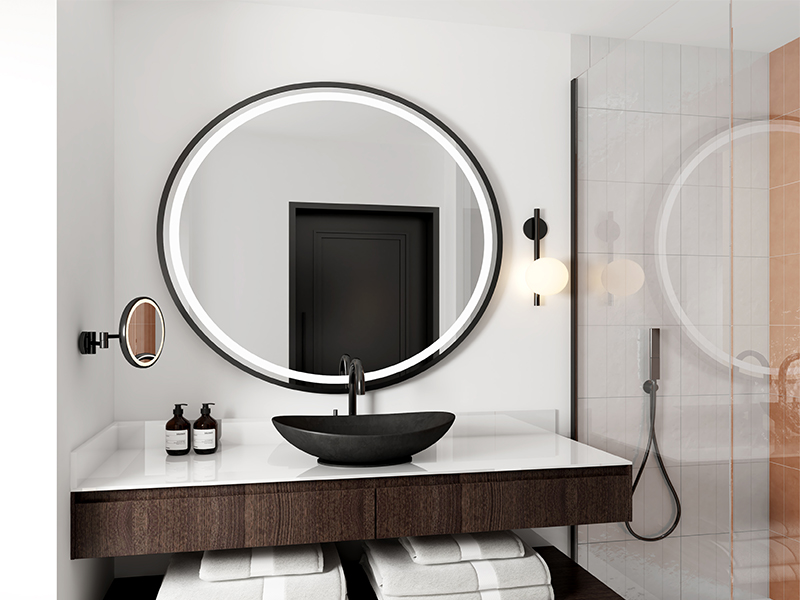
Introduction: Why LED Mirrors Matter in Hospitality Bathrooms
In modern hospitality design, guest bathrooms have evolved far beyond purely functional spaces. They are now a key part of the overall guest experience, where comfort, visual quality and attention to detail directly influence how a hotel or cruise ship is perceived.
LED mirrors play a central role in this transformation. By combining lighting and reflection into a single, integrated element, they shape how guests interact with the space, how materials appear under light, and how refined the environment feels. Well-specified LED mirrors enhance grooming comfort, improve perceived cleanliness, and contribute to a consistent design language that supports brand identity across every room.
Hotels and cruise ships also operate under very different conditions from residential projects. Higher humidity, frequent use, rigorous cleaning routines and the need for uniformity across large numbers of rooms demand higher standards in lighting performance, safety, durability and compliance. Residential-grade mirrors are rarely designed to meet these expectations.
This guide is written for designers, specifiers and project teams working in hospitality. It explains how to evaluate LED mirrors for guest bathrooms, focusing on practical considerations that affect performance, consistency and long-term value in hotel and cruise ship environments.
What Makes an LED Mirror Suitable for Hospitality Use
Not all LED mirrors are designed for the demands of hospitality environments. While residential mirrors may appear similar on the surface, hotels and cruise ships require LED mirror solutions that are engineered for far more intensive use and stricter performance standards.
One of the key differences between residential and hospitality-grade LED mirrors lies in how they are built and tested. Hospitality mirrors must withstand high humidity levels, frequent daily use by different guests, and regular cleaning with commercial products. This requires sealed lighting components, moisture-resistant materials and robust construction that maintains performance over many years, not just during light domestic use.
Consistency is another critical requirement. In hotels and cruise ships, LED mirrors are rarely installed as one-off items. They are specified across dozens or hundreds of guest bathrooms, often across multiple room categories. Lighting colour, brightness, proportions and finishes must remain uniform from room to room to support brand standards and avoid visible inconsistencies that undermine perceived quality.
For this reason, LED mirrors in hospitality should be viewed as complete systems rather than standalone products. The mirror glass, lighting, electrical components, mounting method and control features all work together to determine safety, durability and user experience. A system-based approach ensures that each element performs reliably and consistently, supporting long-term operation and a cohesive guest experience across the entire property.
Choosing the Right Size, Shape, and Proportion
Selecting the correct size, shape and proportion is one of the most important decisions when specifying LED mirrors for hospitality guest bathrooms. These elements directly affect visual balance, usability and the overall sense of quality within the space.
Mirror Size Relative to Vanity and Room Dimensions
The mirror should be proportionate to the vanity or basin it serves. For single basins, the mirror width is typically aligned with or slightly narrower than the vanity to create a clean, balanced appearance. In double-basin layouts, a wider mirror or two evenly sized mirrors are often specified to maintain symmetry and provide equal usability for both guests.
Height is equally important. In standard guest rooms, mirrors should be positioned to comfortably accommodate a wide range of guest heights without overwhelming the wall. In suites or premium rooms, taller mirrors are often used to enhance the sense of space and visual luxury. In compact bathrooms, care must be taken to avoid mirrors that feel either too small to be practical or so large that they dominate the room and disrupt proportions.
Shape Selection for Hospitality Bathrooms
Mirror shape plays a subtle but influential role in hospitality design. Round and oval mirrors introduce softness and help balance strong horizontal and vertical lines created by tiles, cabinetry and fixtures. They are often used to visually expand smaller bathrooms and create a more relaxed, welcoming atmosphere.
Arched and capsule-shaped mirrors are frequently specified in premium guest rooms and suites, where they add elegance and a sense of architectural detail. These shapes can become a defining design feature while still maintaining functional clarity.
Rectangular mirrors remain a practical choice for many hospitality projects. Their clean lines support efficient repetition across large room sets and work well in layouts that prioritise clarity, alignment and ease of coordination with other bathroom elements. When specified correctly, rectangular mirrors deliver consistency without sacrificing design quality.
Lighting Performance That Guests Actually Notice
Lighting quality is one of the most immediate and noticeable aspects of an LED mirror. Guests may not understand technical specifications, but they instantly perceive whether lighting feels comfortable, flattering and consistent. In hospitality bathrooms, lighting performance has a direct impact on usability, mood and perceived quality.
Light Direction and Distribution
The direction and distribution of light determine how well a mirror performs in daily use. Front-lit mirrors provide direct, even illumination onto the face, making them ideal for grooming tasks such as shaving or makeup application. When properly diffused, front lighting reduces shadows and delivers clear, practical visibility.
Back-lit mirrors create a soft halo of light on the wall behind the mirror. This indirect lighting enhances ambience and adds depth to the bathroom, helping finishes such as stone, tile or timber appear more refined. Back lighting is often used to elevate the visual atmosphere rather than to provide primary task lighting.
Dual-lit mirrors combine front and back lighting to deliver both functionality and ambience. This configuration is commonly specified in premium hospitality bathrooms, where guests expect excellent grooming light alongside a layered, luxurious lighting effect.
Colour Temperature and CRI
Colour quality is just as important as brightness. In hospitality environments, a colour rendering index of ninety or higher is widely expected. High CRI lighting ensures that skin tones, finishes and materials appear natural and accurate, improving grooming comfort and enhancing the overall perception of quality.
Selecting the correct colour temperature depends on the interior palette. Warm light complements timber, beige and stone finishes, creating a relaxed and inviting atmosphere. Neutral light offers a balanced, contemporary feel that works well across a wide range of materials. Cooler light is typically reserved for more modern or minimal interiors where crisp clarity is desired.
Consistency is critical in hotels and cruise ships. Colour temperature must remain uniform across all guest bathrooms to maintain brand standards and avoid noticeable variations between rooms. Stable lighting performance ensures every guest experiences the same level of comfort and visual quality, regardless of room location or category.
Safety, IP Ratings, and Compliance in Guest Bathrooms
Safety and compliance are non-negotiable when specifying LED mirrors for hospitality guest bathrooms. Unlike residential environments, hotel and cruise ship guest bathrooms are exposed to higher levels of moisture, frequent use by different guests, and more intensive cleaning routines. These conditions significantly increase the risk of water ingress and electrical failure if mirrors are not designed and installed to appropriate standards.
Moisture protection is essential because steam, condensation and splashing water are present on a daily basis in guest bathrooms. Even areas that appear visually dry can experience prolonged humidity, particularly in compact hotel guest bathrooms or cruise ship cabins with limited ventilation. Without adequate protection, moisture can penetrate electrical components, leading to safety risks, lighting instability and premature failure.
IP ratings provide a clear framework for assessing a product’s resistance to solids and water. In hospitality bathrooms, IP44 is widely recognised as the minimum acceptable rating for LED mirrors. This level of protection ensures resistance to splashing water from all directions, making it suitable for installation above basins and in other moisture-exposed areas commonly found in guest bathrooms.
It is important to understand that IP compliance applies to the entire mirror assembly, not just the LED light source. The mirror glass, lighting system, wiring, drivers, cable entry points and backing materials must all work together to maintain the stated protection level. A mirror with IP-rated LEDs but poorly sealed wiring or backing does not provide genuine IP44 performance in real-world conditions.
A common misconception is that LED mirrors are inherently safe for bathroom use simply because they incorporate low-voltage lighting. In reality, safety depends on proper design, tested construction and verified certification. For hospitality projects, designers and specifiers should always confirm IP ratings through documentation and ensure that mirrors are specifically engineered for guest bathroom environments rather than adapted from residential products.
Durability and Construction for High-Use Environments
In hospitality guest bathrooms, LED mirrors are subjected to far more demanding conditions than in residential settings. High guest turnover, frequent daily use, constant humidity and regular cleaning all place sustained pressure on materials and components. For this reason, durability and construction quality are critical to long-term performance.
Sealed LED modules and protected internal wiring are fundamental to reliable operation. Electrical components must be isolated from moisture and condensation, with secure connections that remain stable over time. Poorly protected wiring is one of the most common causes of flickering, failure and early replacement in high-use environments.
The structural elements of the mirror are equally important. Moisture-resistant backing materials prevent swelling, warping and degradation caused by prolonged exposure to humidity. Frames and fixings must be corrosion-resistant to withstand damp conditions and cleaning chemicals without discolouration or structural weakening. These construction details ensure the mirror maintains both its appearance and safety performance throughout its service life.
Heat management is another key consideration in sealed mirror systems. LED components generate heat during operation, and without effective thermal control, heat build-up can reduce LED lifespan and affect light consistency. Well-engineered mirrors balance moisture sealing with heat dissipation, allowing LEDs and drivers to operate efficiently over many years.
Ultimately, build quality has a direct impact on lifespan and maintenance costs. Durable construction reduces the likelihood of early failures, minimises disruption to hotel operations and lowers long-term replacement and servicing expenses. For hotels and cruise ships operating at scale, investing in robust, hospitality-grade LED mirrors delivers both operational reliability and better overall value.
Smart Features That Add Real Hospitality Value
Smart features in LED mirrors should enhance the guest experience and support hotel operations without drawing attention to themselves. In hospitality environments, the most successful technologies are those that feel intuitive, reliable and seamlessly integrated into daily use.
Demisters are one of the most valued features in guest bathrooms. By preventing fog build-up after showers, they ensure the mirror remains clear at all times. This improves convenience for guests and reinforces perceptions of cleanliness and quality, particularly in premium hotels where expectations are high.
PIR motion sensors add both comfort and efficiency. They allow the mirror to activate automatically during night-time use, providing soft illumination without the need to search for switches. This improves safety and reduces disturbance, while also helping to manage energy consumption across large numbers of rooms.
Integration with lighting control systems such as DALI is increasingly important in hotels and cruise ships. Centralised control enables consistent lighting scenes, simplified maintenance and improved energy management. When LED mirrors are integrated into the wider room lighting strategy, they contribute to a cohesive and well-managed guest environment.
It is also important to recognise when smart features add unnecessary complexity. Overloading mirrors with consumer-style technology can increase failure risk and maintenance demands without delivering meaningful benefits. In hospitality settings, smart features should be selected based on durability, ease of use and long-term value, ensuring they enhance the experience rather than complicate it.
Installation and Electrical Considerations
Correct installation is just as important as product specification when it comes to LED mirrors in hospitality guest bathrooms. Even a well-designed, hospitality-grade mirror can underperform or fail if electrical and installation requirements are not properly addressed.
In most hotel and cruise ship projects, hardwired LED mirrors are preferred over plug-in options. Hardwired installations offer greater security, tamper resistance and a cleaner visual result, which is particularly important in guest environments. They also integrate more effectively with central lighting controls and building management systems. Plug-in mirrors may be used in limited renovation scenarios, but they are generally less suitable for long-term hospitality use due to visible cabling, reduced durability and potential safety concerns.
Professional electrical installation is essential in all hospitality settings. Qualified electricians ensure correct wiring, earthing and circuit protection in line with commercial electrical standards. Proper installation not only protects guest safety but also preserves the mirror’s IP rating and lighting performance. Incorrect wiring or poor connections can lead to flickering, premature component failure or compliance issues during inspection.
Wall preparation and waterproofing must be coordinated before installation begins. Substrates should be stable, level and appropriately sealed to prevent moisture migration behind the mirror. Cable routing should be planned in advance to avoid unnecessary penetrations or on-site modifications that could compromise seals. Close coordination between designers, contractors and installers helps ensure a clean, secure installation.
Poor installation is one of the most common causes of compromised IP performance. Damaged seals, unprotected cable entry points or improvised fixings can allow moisture to enter the mirror assembly, undermining safety and durability. Treating installation as a critical phase rather than a final step ensures LED mirrors perform reliably throughout their intended service life in hospitality environments.
How to Evaluate LED Mirror Suppliers for Hospitality Projects
Selecting the right LED mirror supplier is a critical decision in hospitality projects, particularly when mirrors are specified across large numbers of guest bathrooms and bedrooms. Beyond aesthetics, suppliers must demonstrate the capability to deliver consistent quality, reliable performance and long-term support.
Product quality should always be verified through appropriate test documentation and certifications. This includes confirmation of IP ratings, electrical safety compliance and lighting performance. Reliable suppliers are transparent with technical data and can provide evidence that their mirrors have been tested as complete assemblies rather than individual components.
The ability to deliver consistent output at scale is equally important. Hotels and cruise ships require uniform lighting colour, brightness and finishes across dozens or hundreds of rooms. Suppliers must have the manufacturing control and quality assurance processes in place to maintain consistency throughout large production runs, avoiding visible variations that undermine design standards.
Bespoke design capability is another key factor. Hospitality projects often require made-to-measure mirrors, customised shapes or specific lighting logic. Suppliers who offer CAD drawings, technical detailing and prototype development can support designers and specifiers in refining solutions before production, reducing risk during installation.
Logistics, installation and aftercare capability should also be considered. Efficient packaging, reliable delivery schedules and coordinated installation support help keep projects on programme. Ongoing aftercare, access to spare parts and responsive technical support are essential for maintaining mirrors throughout their service life.
Finally, experience within the hospitality sector matters. Suppliers familiar with hotels, cruise ships and FF&E coordination understand the complexities of large-scale programmes, phased installations and strict brand standards. This experience enables smoother collaboration and more predictable outcomes from specification through to completion.
Why Choose Luma Mirrors by Gemm London for Hospitality Guest Bathroom LED Mirrors
Luma Mirrors by Gemm London is dedicated exclusively to hospitality environments, specialising in LED mirrors for guest bedrooms and bathrooms. This focused approach ensures that every mirror we deliver is designed to meet the specific performance, safety and consistency requirements of hotels and cruise ships.
With proven experience across hotels, cruise ships and large-scale residential developments, we understand the challenges of delivering uniform quality across extensive room programmes. Our mirrors are engineered to perform reliably in high-humidity, high-use environments while maintaining consistent lighting output and finish across every room.
We offer bespoke solutions tailored to each project. From custom shapes and sizes to carefully selected finishes and lighting logic, our mirrors are designed to integrate seamlessly with your interior concept and technical specifications. Every detail is considered to support both visual quality and long-term durability.
Luma’s hospitality-grade LED systems are developed with sealed smart integration, ensuring features such as demisters, PIR sensors and control compatibility are incorporated without compromising safety or performance. This system-based approach delivers reliable operation and a refined guest experience.
Our end-to-end service covers every stage of the project, including survey support, CAD drawings, manufacture, installation and certification. By managing the full process, we help reduce risk, streamline coordination and ensure consistent quality from concept through to completion.
Contact Our Team
We welcome collaboration with designers, specifiers, main contractors, shipyards and FF&E procurement teams working on hospitality projects.
Contact Luma to discuss compliant, hospitality-grade LED mirror solutions tailored to your guest bathrooms and bedrooms. Our team provides support from early design development through installation and certification, helping you deliver reliable performance and consistent quality across your project.
