
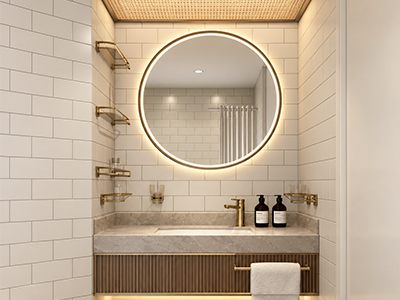
Cruise Ship Vanity Mirrors: Design and Specification Guide
A cruise ship vanity mirror is not necessarily a bathroom mirror. In many cabins, it forms part of a compact dressing, desk, or storage area where guests may sit to apply makeup, style their hair, or prepare for the day. The mirror therefore needs to work as part of the wider cabin furniture layout rather than as a standalone fitting.
A typical cruise ship vanity area may combine a mirror, desk surface, drawers, seating, lighting, and electrical outlets within a very limited footprint. This creates a different set of design challenges from those found in a bathroom. Mirror dimensions, mounting height, guest sightlines, task lighting, socket positions, furniture clearances, and seated versus standing use all need to be considered together.
At Luma Mirrors, these factors can be incorporated into a bespoke mirror specification developed around the cabin design and project requirements.
What Is a Cruise Ship Vanity Mirror?
A cruise ship vanity mirror is a mirror designed for the cabin’s dressing or grooming area rather than specifically for the bathroom. It may be illuminated or non-illuminated and is usually coordinated with the surrounding furniture, seating, lighting, and electrical layout.
Because space inside a cruise cabin is limited, the vanity area often needs to serve several purposes. The same zone may function as a desk, dressing table, storage unit, and charging area. As a result, the mirror must be specified as part of the complete cabin arrangement rather than selected only by shape or appearance.
Vanity Mirrors in Cruise Ship Cabins
A cruise cabin vanity mirror can be positioned in several different areas depending on the cabin type and interior design. Common locations include:
- above a combined desk and vanity area
- over a dedicated dressing table
- mounted on the bedroom wall
- integrated into built-in cabin furniture
- positioned beside a wardrobe or dressing zone
- installed within a larger suite dressing area
In many modern cabins, the desk and vanity are combined into a single piece of multifunctional furniture. Drawers, electrical outlets, lighting, a stool or chair, and the mirror may all need to fit within the same compact area.
This makes coordination especially important. The mirror width and height need to correspond with the furniture dimensions, while its position should provide comfortable sightlines for guests using the vanity from a seated or standing position.
An illuminated vanity mirror for a cruise ship may also need to coordinate with power outlets, USB connections, switches, integrated lighting controls, and other cabin services.
Cruise Ship Vanity Mirror vs Bathroom Mirror
Although both are used for grooming, a cabin vanity mirror and a cruise ship bathroom mirror normally serve different functions and operate within different environments.
| Factor | Cabin Vanity Mirror | Bathroom Mirror |
| Primary use | Dressing, makeup, hair styling and grooming | Washing, shaving and grooming |
| Typical location | Bedroom, desk or dressing area | Bathroom |
| User position | Seated and/or standing | Primarily standing |
| Furniture integration | Desk, drawers, wardrobe or dressing table | Basin and bathroom vanity unit |
| Lighting emphasis | Facial and task lighting | Task and general bathroom lighting |
| Moisture exposure | Generally lower | Generally higher |
| Electrical coordination | Sockets, USB outlets, hairdryer and charging points | Bathroom electrical installation |
| Design role | Strong decorative and functional role within the cabin | Functional element integrated into the bathroom design |
The distinction matters during specification. A marine vanity mirror used above a cabin desk needs to work with furniture proportions, seating positions, guest sightlines, task lighting, and nearby electrical outlets. A bathroom mirror, by comparison, needs greater consideration of the wet-area environment and the bathroom layout.
For this reason, the same mirror specification should not automatically be used for both locations simply because they are installed within the same cabin.
How to Determine Cruise Ship Vanity Mirror Size
The correct size for a cruise ship vanity mirror depends on more than the available wall area. In a compact cabin, the mirror is usually part of a coordinated furniture and lighting arrangement, so its dimensions should be developed together with the desk, storage, seating, electrical points, and surrounding finishes.
Start With the Available Furniture Width
The first step is to review the complete vanity or desk elevation rather than looking at the mirror in isolation.
Key elements may include:
- vanity or desk width
- drawer units
- wardrobes
- minibar cabinets
- television position
- adjacent wall panels
- switches and electrical sockets
- USB or charging outlets
- decorative trims and lighting
These components can significantly limit the usable mirror area.
For example, a mirror that appears suitable on a general cabin plan may conflict with a nearby wardrobe door, socket plate, television, or furniture trim once the detailed elevation is developed. The mirror may also need to align with the centreline of the desk or with other repeated elements within the cabin.
For this reason, mirror dimensions should not be specified independently of the cabin furniture package. Designers, furniture suppliers, electrical teams, and the mirror manufacturer should work from coordinated drawings before the final size is approved.
Mirror Width and Visual Proportion
There is no single correct width for a cruise cabin vanity mirror. The proportion should suit both the function of the vanity and the overall interior design.
Depending on the cabin concept, the mirror may:
- approximately match the width of the desk or vanity
- sit neatly within a defined furniture module
- be deliberately narrower to create a more decorative focal point
- extend vertically to increase the usable reflection area without occupying excessive wall width
A wider landscape mirror can work well above a broad desk and may help make the cabin feel more open. A narrower portrait mirror can be more effective where wall width is limited or where both seated and standing use are required.
The surrounding furniture should also remain visually balanced. An oversized mirror can dominate a compact vanity, while a mirror that is too small may appear disconnected from the desk and provide insufficient usable reflection.
The final proportion should therefore be assessed as part of the complete cabin elevation rather than by applying a fixed mirror-to-vanity ratio.
Mirror Height and Guest Sightlines
Mirror height is particularly important because a cabin vanity mirror may need to serve guests both while seated and while standing.
The specification should consider:
- typical seated eye level
- standing eye level
- stool or chair height
- height of the desk or vanity surface
- variation in guest height
- distance between the guest and the mirror
- required viewing area for the face and upper body
If the lower edge of the mirror is positioned too high, a seated guest may have a poor view. If the mirror is too shallow vertically, it may work well while seated but become inconvenient for standing use.
Taller mirrors are often useful where one vanity needs to accommodate both positions. However, the actual mounting height should be determined from the furniture dimensions and expected viewing distance rather than from a standard wall height.
For cruise ship projects, these sightlines are best checked during the cabin mock-up stage. Testing the mirror together with the actual desk, chair, lighting, and surrounding furniture can reveal ergonomic issues that may not be obvious from drawings alone.
Seated vs Standing Use: Designing for Guest Ergonomics
A cruise ship vanity mirror may be used in more than one position throughout the day. A guest might sit at the vanity to apply makeup or style their hair, then later stand in front of the same mirror to check clothing or appearance.
For this reason, mirror placement should be based on actual guest use rather than appearance alone.
Designing for Seated Grooming
When the vanity or desk is intended to double as a dressing area, seated use becomes especially important.
Typical activities may include:
- applying makeup
- styling hair
- skincare and grooming
- preparing for dinner or evening events
- using the desk as a temporary dressing table
The mirror should provide a comfortable view without requiring the guest to lean forward or change position excessively.
Key points to check include:
- seated face and eye position
- height of the mirror’s lower edge
- viewing angle
- distance from the mirror
- chair or stool height
- knee clearance below the desk
- ability to move the chair comfortably
- whether lighting reaches the face evenly while seated
The relationship between the chair, desk surface and mirror is particularly important. A mirror positioned too high may work perfectly for a standing guest but provide poor visibility when someone is seated.
Designing for Standing Use
The same cabin vanity mirror may also need to work comfortably when the guest is standing.
In this position, designers should consider:
- standing eye level
- visibility of the face and upper body
- overall usable reflection area
- distance between the guest and the mirror
- whether furniture prevents the guest from standing close enough to the mirror
The desk or vanity itself can increase the viewing distance, so a mirror that appears large enough on an elevation may provide less usable reflection than expected once the furniture is installed.
For standing use, sufficient vertical mirror area is often more useful than simply increasing width.
Designing One Mirror for Both Positions
Designing one mirror to perform well for both seated and standing guests usually requires a compromise between mounting height, mirror proportion and available wall space.
Solutions may include:
- using a taller mirror
- choosing a portrait or vertically extended proportion
- positioning the lower edge carefully
- increasing the usable reflective area
- aligning the mirror with the centre of the seated position
- checking how far the guest will stand from the mirror
The objective is not necessarily to maximise the mirror size, but to create a usable reflection zone across the expected range of guest positions.
This is one reason why a representative cabin mock-up is valuable before full production. Testing the vanity mirror with the actual furniture, chair, lighting and surrounding cabin elements allows designers to confirm both seated and standing sightlines before the same specification is repeated across multiple cabins.
Lighting a Cruise Ship Vanity Mirror
Lighting is a key part of the performance of a cruise ship vanity mirror. In a compact cabin, the vanity may be one of the main places where guests apply makeup, shave, style their hair, carry out skincare routines, or prepare for dinner. The mirror therefore needs to provide useful facial illumination while also fitting comfortably within the overall cabin lighting scheme.
The aim is not simply to make the mirror brighter. Good vanity lighting should illuminate the face evenly, limit harsh shadows and glare, and remain comfortable at the relatively short viewing distances common in cruise cabins.
Why Task Lighting Matters at the Vanity
General cabin lighting may not provide the quality or direction of light required for detailed grooming tasks.
At the vanity, guests may use the mirror for:
- applying makeup
- shaving
- skincare
- styling hair
- checking clothing and appearance
- preparing for evening dining or events
For these activities, light needs to reach the face rather than simply illuminate the surrounding cabin.
A well-designed illuminated vanity mirror for a cruise ship can provide dedicated task lighting at the point where it is needed. This can also reduce dependence on ceiling lights, which may create shadows around the eyes, nose, and chin when used alone.
Because the vanity is a frequently used guest touchpoint, relatively small differences in mirror lighting can have a noticeable effect on how functional and comfortable the cabin feels.
Front-Lit vs Backlit Vanity Mirrors
Both front-lit and backlit mirrors can be used within cruise ship interiors, but they perform different roles.
Front-lit vanity mirrors direct more light towards the user and are generally better suited to detailed grooming tasks. Illuminated sections positioned around the mirror face can help provide clearer facial lighting for makeup, shaving, and skincare.
They are particularly useful where:
- the vanity is the main grooming area outside the bathroom
- general cabin lighting is relatively soft
- guests need good facial visibility
- the mirror is used from a close distance
Backlit vanity mirrors, by comparison, create a softer glow around the mirror and can contribute to the cabin’s overall ambience. They work particularly well where the design team wants the mirror to appear visually lighter or create a decorative lighting effect against the wall or furniture panel.
However, backlighting alone may not provide sufficient direct light on the user’s face for detailed grooming.
For many vanity applications, front lighting or a combination of task and ambient lighting provides a better balance between functionality and visual appearance.
The final solution should still be coordinated with the cabin’s wider lighting design rather than treating the mirror as an independent light source.
Reduce Shadows on the Face
A vanity mirror can be bright without necessarily providing good facial illumination.
Strong light coming primarily from above can create shadows beneath the eyes, nose, and chin. Similarly, highly directional illumination from only one side of the mirror can make one side of the face noticeably brighter than the other.
More even lighting can be achieved by considering:
- illumination from multiple directions
- vertical or perimeter-lit mirror designs
- balanced light distribution across the mirror
- suitable distance between the LED source and diffuser
- interaction with nearby cabin lighting
For grooming applications, the objective should be to create consistent illumination across the face, rather than simply achieving the highest possible light output.
This needs to be checked from the guest’s actual viewing position. A lighting arrangement that looks balanced on an elevation may perform differently once the desk, chair, and surrounding furniture determine where the guest actually sits.
Avoid Glare and Visible LED Hotspots
Glare is particularly noticeable in cruise ship cabins because the guest is often relatively close to the mirror.
The lighting specification should therefore consider:
- quality of LED diffusion
- visible LED hotspots
- brightness at close viewing distances
- reflections from glossy furniture or metallic finishes
- reflected light from other cabin fixtures
- the position of the guest relative to the illuminated sections
A continuous, evenly diffused lighting surface usually creates a more comfortable appearance than individual LED points that remain visible through the illuminated section.
Brightness also needs to be considered in context. A mirror that appears comfortable in a bright showroom may feel excessively intense inside a compact cabin with relatively low ambient lighting.
For this reason, mirror lighting should ideally be reviewed together with the cabin lighting and interior finishes during the design or mock-up stage.
Detailed decisions regarding colour temperature, CRI, lighting output, and control options should be coordinated with the wider project lighting specification. For a deeper discussion of these factors, see our guide to cruise ship mirror lighting: CRI, CCT and brightness.
Coordinating Power Sockets Around the Vanity Area
A cruise ship vanity is often more than a dressing space. It may also function as one of the cabin’s main locations for charging devices, using personal grooming equipment, or working at a laptop. Depending on the vessel and cabin design, the vanity area may therefore include a combination of 110V or 220V sockets, USB outlets, USB-C connections, switches, and other electrical controls.
For an illuminated cruise ship vanity mirror, these guest-facing electrical points must also be coordinated with the mirror’s own power supply, cable routing, controls, and mounting arrangement.
Common Guest Requirements
Guests may use the vanity area for a wide range of electrical devices, including:
- hair dryers
- hair straighteners or styling tools
- electric shavers
- mobile phones
- tablets
- laptops
- cameras and other rechargeable devices
This means socket placement should be considered according to how the guest will actually use the desk or dressing area.
A socket that is technically accessible but positioned behind the mirror, too close to furniture edges, or difficult to reach while seated can reduce the usability of the vanity.
The design team should also consider how devices and charging cables will sit on the desk surface. Poorly positioned outlets can result in cables crossing the working area or interfering with drawers, mirrors, or other cabin fittings.
Mirror and Socket Positioning
Mirror dimensions and mounting positions should be checked against the complete electrical elevation before production.
Potential conflicts include:
- socket plates
- light switches
- USB and USB-C outlets
- mirror cable exits
- mirror controls
- furniture panels
- decorative trims
- drawers and cabinet doors
For example, increasing the width of a cabin vanity mirror late in the design process may cause it to overlap an outlet that was previously positioned beside the mirror. Likewise, changing the mirror from a frameless design to a wider framed model may alter the required clearance around switches or sockets.
The location of integrated touch controls also needs consideration. If the LED mirror includes its own switch, dimming control, or other interface, this should not create unnecessary duplication or confusion with nearby wall controls.
Accurate coordinated elevations help identify these issues before either the furniture or mirror enters production.
Coordinate Electrical Requirements Early
Electrical coordination should begin before the mirror production drawings are approved.
The mirror supplier, furniture contractor, interior designer, and electrical/MEP team should confirm information such as:
- mirror power requirements
- project voltage
- connection method
- cable entry position
- driver location
- switch or control method
- socket and USB positions
- furniture penetrations or cable routes
- access required for servicing electrical components
This is particularly important where the mirror is integrated tightly into custom cabin furniture. Once wall panels, sockets, and furniture modules have entered production, even a relatively small change to the mirror dimensions or cable position can affect several other trades.
For bespoke cruise ship projects, Luma Mirrors can coordinate the mirror dimensions, electrical requirements, cable exits, and control options with the relevant cabin drawings before production. This helps ensure the finished vanity mirror integrates correctly with both the furniture package and the vessel’s electrical design.
Integrating the Vanity Mirror With Cabin Furniture
A cruise ship vanity mirror should be treated as part of the complete cabin furniture package rather than as an isolated wall-mounted product. In many cabins, the mirror sits directly above or within a custom desk, dressing table, wardrobe, or storage unit, so small changes in size or position can affect several surrounding components.
Early coordination helps ensure the mirror looks intentional, functions correctly, and can be installed without clashes with furniture, doors, electrical outlets, or seating.
Coordinate With the Desk or Dressing Table
The starting point should be the full furniture elevation.
Key dimensions and interfaces to review include:
- desk or dressing-table width
- mirror centreline
- height of the worktop
- drawer positions
- seating location
- storage compartments
- cable routes
- decorative trims or panels
The mirror may align with the centre of the desk, sit within a defined furniture module, or form part of a larger asymmetrical composition. Whichever approach is used, the relationship between the mirror and furniture should be deliberate.
The mirror should also be checked against how the desk is actually used. Drawers need to open freely, the chair or stool should remain comfortable to position, and electrical cables should not be forced across the working surface simply because the mirror or socket locations were developed separately.
For illuminated mirrors, cable entry points and driver locations should also be coordinated with the furniture design so that services remain concealed but accessible.
Wardrobe and Door Clearances
Clearances become particularly important in compact cruise cabins, where several moving elements may occupy the same small area.
The mirror and vanity zone should be checked against:
- wardrobe door opening
- sliding panels
- drawers
- cabinet doors
- minibar doors
- chair or stool movement
- nearby cabin doors
A mirror that fits correctly on the wall elevation may still create practical problems if it interferes with the movement of an adjacent wardrobe door or forces the chair into a circulation route.
This is especially important where mirrors project from the wall because of frames, integrated lighting, mounting systems, or concealed electrical components.
Design teams should therefore review both the front elevation and plan view of the vanity area before the mirror dimensions and mounting depth are finalised.
Coordinate Mirror Finishes With Cabin Interiors
The vanity mirror also contributes to the overall interior design of the cabin.
Possible treatments include:
- aluminium frames
- brushed or polished metallic finishes
- black frames
- bronze or champagne finishes
- custom-coloured frames
- frameless designs
The selected finish can be coordinated with other visible cabin elements such as:
- furniture handles
- taps and bathroom hardware
- light fittings
- furniture trims
- wardrobe hardware
- decorative metal details
This helps the mirror feel integrated with the wider cabin design rather than added as a separate product.
Finish selection should also consider the actual lighting conditions within the cabin. Metallic surfaces, for example, can appear noticeably different under warm and cool lighting.
For this reason, frame samples are best reviewed alongside the relevant furniture finishes, handles, fittings, and lighting samples before final approval. This allows designers and specifiers to assess colour, reflectivity, texture, and overall visual consistency as part of the complete interior scheme.
Choosing the Shape of a Cruise Cabin Vanity Mirror
The shape of a cruise cabin vanity mirror should suit both the cabin design and the available furniture layout. Designers should consider the vanity width, wall space, guest sightlines, and surrounding furniture before finalising the mirror shape.
Rectangular Mirrors
Rectangular mirrors work well with:
- contemporary cabins
- modular furniture
- wider desk or vanity areas
They are easy to align with drawers, wall panels, sockets, and lighting, making them a practical choice for many cabin layouts.
Round and Oval Mirrors
Round and oval mirrors are useful for:
- softer interior schemes
- premium cabins
- creating contrast with linear furniture
They can also become a decorative focal point, especially when combined with integrated lighting.
Arched and Custom-Shaped Mirrors
Arched or bespoke shapes are well suited to:
- suites
- luxury interiors
- brand-specific design concepts
Custom shapes can help the mirror integrate more closely with the overall cabin design, but they should be confirmed early because they can affect manufacturing, lighting, mounting, and packaging.
Portrait vs Landscape Orientation
Portrait mirrors provide more vertical viewing area and can work well for both seated and standing guests.
Landscape mirrors are better suited to wider desk or vanity units and can help visually connect the mirror with the furniture below.
The final choice should balance appearance, available space, and practical guest use.
Specification Checklist for a Cruise Ship Vanity Mirror
Before approving a cruise ship vanity mirror for production, designers and specifiers should confirm the key dimensional, lighting, electrical, and furniture requirements. A clear specification helps reduce coordination issues during sampling, manufacturing, and installation.
| Specification Item | What to Confirm |
| Cabin type | Standard cabin, balcony cabin, suite, accessible cabin |
| Mirror location | Desk, vanity, dressing zone |
| Overall size | Width × height |
| Viewing requirement | Seated, standing, or both |
| Shape | Rectangular, round, oval, arched, or custom |
| Frame | Frameless or framed |
| Finish | Coordination with cabin furniture and hardware |
| Lighting | Front-lit, backlit, or dual |
| CCT | Required project colour temperature |
| CRI | Required colour rendering performance |
| Controls | Wall switch, touch control, dimming, or integrated system |
| Voltage | Project electrical requirement |
| Power position | Cable exit and driver location |
| Sockets | Position relative to the mirror and furniture |
| Mounting | Agreed fixing or mounting system |
| Service access | Access to driver and electrical components |
| Furniture interface | Desk, drawers, wardrobe, and wall panels |
| Accessibility | Seated sightlines and reachable controls |
| Quantity | Required quantity by cabin type |
| Sample / mock-up | Whether approval is required before bulk production |
This checklist should be reviewed together with the cabin elevation, furniture drawings, and electrical layout. For bespoke projects, completing these details early gives the mirror supplier a much clearer basis for developing drawings, samples, and the final production specification.
Prototype and Mock-Up Testing Before Production
Before bulk production, the cruise ship vanity mirror should be reviewed within a representative cabin mock-up wherever possible. Drawings can confirm dimensions, but they cannot always show how the mirror will feel and perform in actual use.
The mock-up should be used to check:
- seated and standing sightlines
- lighting performance
- glare and visible hotspots
- reflection quality
- alignment with furniture
- socket and switch access
- chair clearance
- wardrobe and door clearance
- frame and finish coordination
This stage is especially valuable when the mirror is integrated closely with custom furniture or lighting. Small issues identified during the mock-up can be corrected before the same design is repeated across a large number of cabins.
Common Cruise Ship Vanity Mirror Specification Mistakes
Even a well-designed cruise ship vanity mirror can create problems if it is specified without enough coordination with the cabin layout, furniture, lighting, and electrical design.
Treating the Vanity Mirror Like a Bathroom Mirror
A cabin vanity mirror serves different user behaviour. It may be used while seated, as part of a desk or dressing area, and usually has different lighting and furniture relationships from a bathroom mirror.
Specifying the Mirror Before the Furniture
Finalising the mirror too early can create alignment, clearance, and proportion issues once the desk, drawers, wardrobe, and wall panels are developed.
Designing Only for Standing Guests
If the vanity is intended for seated grooming, the lower edge and overall height must also work from a seated position. Otherwise, the guest may have poor visibility.
Using Decorative Backlighting as the Only Task Light
Backlighting can create an attractive ambient effect, but it may not provide enough direct facial illumination for makeup, shaving, or skincare.
Forgetting Power Socket Locations
Mirror dimensions and frame profiles should be checked against sockets, USB outlets, switches, and cable exits to avoid clashes during installation.
Ignoring Service Access
LED drivers and electrical components may require future inspection or replacement. The design should therefore allow practical access without unnecessarily disturbing surrounding furniture.
Approving the Mirror Without a Cabin Mock-Up
Small issues with sightlines, glare, chair clearance, or furniture alignment can become costly when the same specification is repeated across many cabins. A representative mock-up helps identify these problems before bulk production.
How Luma Supports Cruise Ship Vanity Mirror Projects
Luma Mirrors by Gemm London works with designers, specifiers, shipyards, marine fit-out companies, and contractors to develop bespoke cruise ship vanity mirrors around the requirements of each cabin and project.
Support can include:
- bespoke mirror dimensions
- custom shapes and profiles
- framed or frameless designs
- frame finish selection
- front-lit, backlit, or dual-lighting solutions
- coordination of CCT, CRI, and lighting performance
- electrical and cable-entry coordination
- technical drawings
- samples and finish approvals
- prototype development
- production for project quantities
- coordination with cabin furniture and marine fit-out teams
- installation and mounting requirements
The objective is to ensure the mirror works as part of the complete cabin design, rather than as a standalone product. This includes coordinating dimensions, lighting, furniture interfaces, electrical requirements, finishes, and installation details before full production begins.
Planning Vanity Mirrors for a Cruise Ship Project?
Send Luma Mirrors your cabin drawings, furniture elevations, mirror schedule, or design concept. Our team can help develop a bespoke vanity mirror solution around your cabin dimensions, lighting requirements, finishes, and project programme.
