
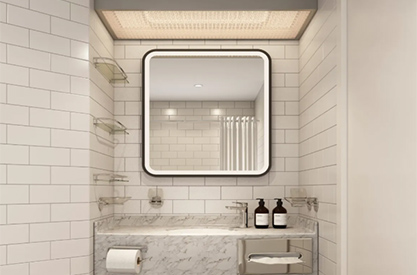
Why Cruise Ship Bathroom Mirrors Need a Different Specification

At first glance, cruise ship bathroom mirrors may look very similar to mirrors used in hotels, apartments, or other commercial bathrooms. In practice, however, they must perform within a much more demanding environment. A mirror installed on a vessel is not simply a decorative element fixed above a vanity. It forms part of a compact marine interior where space, weight, movement, moisture, electrical services, installation methods, and long-term maintenance all need to be considered together.
Cruise ship bathrooms are typically designed within highly restricted cabin layouts, meaning the available wall area can be limited by vanities, shower screens, doors, lighting, ventilation systems, and other fittings. For this reason, marine bathroom mirrors often need to be manufactured to project-specific dimensions rather than selected from standard product sizes.
The marine environment introduces additional technical considerations. Unlike a hotel room, a cruise ship is continuously exposed to vibration and vessel movement. Fixings, frames, mirror backing, electrical components, and surrounding materials therefore need to be selected with long-term stability in mind. High humidity and frequent condensation also make moisture resistance and corrosion protection particularly important for ship bathroom mirrors.
Project scale creates another key difference. A single mirror design may be repeated across dozens or hundreds of cabins. A small issue with dimensions, fixing positions, lighting colour, or electrical access can therefore become a significant installation problem when multiplied across an entire vessel.
For designers, shipyards, marine fit-out contractors, and specifiers, the objective is not simply to choose an attractive mirror. A successful cruise cabin bathroom mirror must coordinate with the cabin structure, vanity layout, electrical system, installation programme, and future maintenance requirements.
This is why bathroom mirrors for ships should be treated as project-specific components, with their specification developed as part of the wider cabin design rather than as a late-stage decorative purchase.
Limited Bathroom Space Changes Mirror Dimensions and Design
Space is one of the most important factors when specifying cruise ship bathroom mirrors. Cruise cabin bathrooms are usually designed to maximise functionality within a compact footprint, so every wall surface needs to work efficiently. Unlike many hotel bathrooms, there may be very little flexibility to move a vanity, light fitting, shower screen, door, or storage unit simply to accommodate a standard mirror size.
The mirror therefore needs to be designed around the bathroom layout rather than added after the main interior elements have already been fixed.
Its width may be controlled by the vanity below, while its height can be affected by ceiling details, lighting, ventilation grilles, shelving, or other fittings. Clearance may also be needed around shower doors, wall-mounted accessories, sockets, or control panels. In some cabins, even a relatively small dimensional change can affect whether the mirror fits correctly or interferes with another component.
This is one reason marine bathroom mirrors are often specified as bespoke project components. The mirror dimensions, shape, frame profile, lighting arrangement, and mounting depth can all be coordinated with the available wall area and the wider cabin design.
Custom Dimensions vs Standard Mirror Sizes
Standard mirror sizes can work well in residential or straightforward commercial applications, but they are often less suitable for marine projects where the available space has already been tightly defined.
A custom cruise cabin bathroom mirror can be manufactured to match the exact width of a vanity, align with adjacent wall finishes, or fit beneath a soffit or lighting feature. Custom sizing can also help designers maintain consistent proportions across different cabin categories where bathroom dimensions vary slightly.
Accurate coordination becomes especially important when the same mirror design is repeated across many cabins. Drawings should clearly define the finished dimensions, mounting position, frame depth, cable entry points, and any required cut-outs or clearances before production begins.
Project-specific sizing also reduces the need for on-site modification. Cutting, repositioning, or adjusting surrounding finishes during installation can slow the fit-out programme and create inconsistency between cabins. For this reason, approved drawings and production tolerances are an important part of the specification process for bathroom mirrors for ships.
Using Mirrors to Make Small Cruise Bathrooms Feel Larger
Although the available space is limited, the mirror itself can help improve the visual perception of the bathroom.
A well-proportioned mirror reflects light and extends sightlines, which can make a compact cabin bathroom feel brighter and less enclosed. Larger mirror surfaces can be especially effective when they are carefully aligned with the vanity and surrounding finishes, creating a cleaner and more continuous visual surface.
Integrated lighting can strengthen this effect. Front-lit or perimeter-lit designs can provide useful facial illumination while also reducing the need for additional wall-mounted fittings around the vanity. Backlighting can create a softer visual effect and help separate the mirror from the wall, although the final lighting approach should always be coordinated with the overall bathroom lighting scheme.
Frame design also matters. Heavy or visually bulky frames can make a small wall area feel more restricted, while slim-profile or frameless designs may create a lighter appearance. Rounded corners, custom shapes, and carefully controlled proportions can help the mirror feel integrated into the cabin rather than added as a separate object.
The goal is not simply to install the largest possible ship bathroom mirror. The mirror should be proportioned so that it improves usability, supports the interior design, and makes efficient use of the limited space without creating conflicts with surrounding fittings.
Mirror Weight Matters More at Sea
Weight is an important consideration when specifying cruise ship bathroom mirrors because the mirror forms part of a much larger weight-sensitive interior system. On a cruise vessel, designers and fit-out teams need to consider not only the appearance and functionality of each component, but also how its weight interacts with cabin wall construction, fixings, handling, installation, and the vessel’s wider design requirements.
For this reason, a marine grade bathroom mirror should not simply be selected on the assumption that heavier means stronger or better. The correct approach is to coordinate the mirror weight with the substrate, mounting method, frame construction, and integrated components.
Mirror thickness is one contributor to overall weight, but it is not the only one. Frames, backing materials, LED systems, demister pads, drivers, mounting brackets, and other integrated features can all increase the finished weight of the unit. A large illuminated mirror may therefore require a very different fixing strategy from a smaller frameless mirror, even if both are installed in similar cabin bathrooms.
Weight also affects installation efficiency. Mirrors may need to be moved through narrow corridors, lifts, cabin entrances, and confined bathroom spaces before being positioned accurately on the wall. A design that is unnecessarily heavy can make handling more difficult and increase the number of installers required.
At the same time, reducing weight should never compromise safety, rigidity, optical quality, or long-term durability. The objective is to develop a balanced specification that achieves the required performance while avoiding unnecessary material or bulk.
For repeated cabin installations, this becomes even more important. A small reduction in unit weight can make handling and installation easier across a large number of cabins, while a poorly coordinated heavy mirror can create recurring problems for fit-out teams.
This is why the weight of bathroom mirrors for ships should be considered early in the design process and reviewed together with the cabin wall system and fixing method, rather than treated as an isolated product specification.
Humidity and Condensation Are Continuous Design Considerations
Cruise ship bathrooms experience frequent changes in temperature and humidity, particularly after showers in compact cabin spaces. This makes moisture management an important part of specifying cruise ship bathroom mirrors.
Condensation does not only affect the visible mirror surface. Over time, moisture can also reach the mirror edges, backing, frame, fixings, adhesives, and nearby electrical components. If these areas are not properly considered, repeated exposure can contribute to staining, deterioration, corrosion, or reduced service life.
For this reason, marine bathroom mirrors should be selected as part of a wider moisture-resistant bathroom specification. The mirror itself, its surrounding materials, the mounting system, and any integrated lighting or demisting components should all be suitable for the intended environment.
Ventilation remains important, but the mirror specification should not rely on ventilation alone. Cruise cabin bathrooms are compact, heavily used spaces, so periods of high humidity and temporary condensation should be expected during normal operation.
Why Mirror Edges and Backing Matter
The edges and rear surface of a mirror are easy to overlook because they are usually hidden after installation. However, these areas can have a major influence on long-term performance.
The reflective coating of a mirror sits behind the glass. If moisture repeatedly reaches vulnerable edges or damaged backing layers, deterioration can begin around the perimeter and gradually become visible from the front.
For a marine grade bathroom mirror, designers and suppliers should therefore consider the quality of the mirror backing, edge treatment, manufacturing process, and how the finished unit will be installed against the wall.
Careful edge finishing can also help reduce locations where moisture can collect. Where frames are used, their joints and interfaces should be considered as part of the moisture strategy rather than simply as decorative details.
Installation is equally important. A well-specified mirror can still perform poorly if moisture becomes trapped behind it or if unsuitable adhesives, fixings, or surrounding materials are used. Adequate coordination between the mirror manufacturer and marine fit-out contractor helps ensure that the complete installation performs as intended.
When a Demister Should Be Considered
A demister can improve usability where condensation on the mirror surface is likely to be a regular issue.
Typically, a demister uses a low-profile heating element positioned behind part of the mirror. When activated, it gently warms the glass in the heated area, helping to reduce condensation after a shower.
For cruise bathroom mirrors, this can be particularly useful because cabin bathrooms are compact and guests may need to use the mirror immediately after showering.
However, a demister should not automatically be added to every mirror. The decision should consider:
- mirror size and intended demisted area
- available electrical capacity
- control method
- energy consumption
- positioning of the heating element
- access for maintenance or replacement
- coordination with lighting and other electrical components
The demister coverage also needs to match the way the mirror will actually be used. Heating a small central area may be sufficient for some projects, while larger mirrors may require a wider demisted zone.
Where a demister is specified, it should be coordinated early with the electrical design rather than added late in production. This ensures that power, switching, cable routing, and servicing requirements are properly incorporated into the final ship bathroom mirror design.
Ultimately, good moisture performance depends on more than simply keeping the front surface clear. A durable cruise ship mirror specification should consider condensation across the entire assembly, including the glass, edges, backing, frame, fixings, and integrated electrical features.
Marine Corrosion Changes the Material Selection
Corrosion resistance is an important consideration when specifying cruise ship bathroom mirrors. Marine interiors are exposed to persistent humidity, condensation, cleaning chemicals, and, depending on the location and operating conditions, varying levels of salt-laden air. These conditions can accelerate deterioration if the mirror assembly contains materials or finishes that are not suitable for a marine environment.
For this reason, material selection should extend beyond the mirror glass itself. A complete marine bathroom mirror may include a frame, brackets, screws, backing panels, electrical connectors, LED components, demister elements, and other hardware. Each of these components can influence long-term appearance and reliability.
Corrosion often begins in less visible areas, such as behind the mirror, around fixing points, at frame joints, or where dissimilar metals meet. If these areas are poorly protected, staining, surface breakdown, loosening of fixings, or premature component failure can occur over time.
A suitable marine grade bathroom mirror therefore needs to be considered as a complete assembly. Designers and suppliers should review the material compatibility of the glass, backing, frame, fixings, electrical components, and surrounding finishes rather than relying on a single “marine-grade” material to solve every corrosion risk.
Frame and Hardware Materials
The choice of frame and hardware can significantly affect the durability of ship bathroom mirrors.
Aluminium is often considered for mirror frames because it offers a good strength-to-weight ratio and can be finished in a wide range of colours and appearances. Appropriate surface treatments and coatings can also improve its resistance to moisture and corrosion.
Stainless steel may be selected where greater robustness or a particular visual finish is required. However, the exact grade and finish should be chosen according to the project environment rather than assuming that all stainless steel performs the same way.
Fasteners, brackets, and concealed hardware are equally important. A visually high-quality mirror can still develop problems if screws, clips, or mounting components corrode behind the finished surface. Hardware should therefore be specified for compatibility with the surrounding materials and the expected exposure conditions.
Designers should also consider the risk of galvanic corrosion where different metals are placed in direct contact. Isolating incompatible materials or selecting suitable combinations can help reduce this risk.
Ultimately, the best material specification is the one that balances corrosion resistance, weight, appearance, manufacturability, installation requirements, and maintenance. For bathroom mirrors for ships, this coordinated approach is far more reliable than choosing materials based on appearance alone.
Vibration and Vessel Movement Affect Mirror Mounting
Unlike mirrors installed in hotels or residential buildings, cruise ship bathroom mirrors are fitted within a structure that is continually exposed to movement and vibration. Even when a vessel is operating normally, low-level vibration can be transmitted through cabin walls, furniture, and interior fittings over long periods of time.
This makes the mounting method especially important. The mirror must remain securely positioned not only during installation, but throughout repeated voyages, changes in sea conditions, routine maintenance, and the normal movement of the vessel.
For marine bathroom mirrors, the fixing strategy should therefore be developed alongside the mirror size, weight, frame design, and wall construction. A mounting system that performs well on a conventional masonry or stud wall may not automatically be suitable for a lightweight marine partition.
The design also needs to prevent unnecessary movement between the mirror and the substrate. Small amounts of repeated movement can place stress on fixing points, adhesives, frames, or electrical connections, particularly where the mirror includes integrated LED lighting or a demister.
The objective is not simply to use stronger fixings. A reliable installation depends on matching the mounting method to the complete mirror assembly and the structure behind it.
The Fixing System Must Work With the Wall Construction
Cruise ship cabin walls can use lightweight panel systems, modular bathroom structures, or other marine interior constructions that differ significantly from conventional building walls. This means the substrate should be understood before the mirror fixing method is finalised.
Depending on the project, ship bathroom mirrors may use concealed brackets, mechanical fasteners, approved adhesive systems, mounting tapes, or a combination of fixing methods. The correct solution depends on factors such as:
- mirror dimensions and total weight
- wall panel construction
- available fixing points
- frame and backing design
- required installation tolerance
- access for future removal
- electrical cable locations
- vibration and movement
- surrounding finishes
Where mechanical fixings are used, loads should be transferred into suitable structural points rather than relying on a surface layer that may not be designed to carry the mirror weight.
Adhesive systems also need careful consideration. Compatibility with the mirror backing and wall material is important, as is performance under moisture, temperature changes, and long-term vibration. Installation teams should follow the approved fixing method consistently across the vessel rather than making cabin-by-cabin adjustments on site.
Serviceability should also be considered. In some projects, the mirror may need to be removed later to access wiring, replace a driver, or repair another component. A fixing system that provides secure installation while allowing controlled removal can make future maintenance significantly easier.
For this reason, the mounting details for bathroom mirrors for ships should be confirmed during the design and drawing stage. Coordinating the mirror supplier, shipyard, and marine fit-out contractor early helps reduce installation problems and ensures that the fixing system is compatible with both the mirror and the cabin wall construction.
Electrical Integration Must Be Planned Early for LED Mirrors
For illuminated cruise ship bathroom mirrors, electrical integration needs to be considered from the beginning of the design process. Unlike a conventional non-illuminated mirror, an LED mirror may need to coordinate with power supplies, switches, dimming controls, demisters, cable routes, drivers, and the wider cabin electrical system.
This makes early coordination essential. If electrical requirements are confirmed too late, the project may face problems such as incorrect cable positions, insufficient access behind the mirror, conflicts with wall structures, or the need to modify finished surfaces during installation.
The first step is to define exactly what the mirror needs to do. Some marine bathroom mirrors may require only integrated LED lighting, while others may include dimming, touch controls, demisters, or separate lighting zones. Each added function affects the electrical design and should be reflected in the project drawings and specification.
Cable entry points are particularly important. Their location needs to align with both the mirror construction and the services provided within the cabin wall. A small mismatch between the electrical outlet and the mirror connection point can become a recurring installation problem when the same design is used across many cabins.
Designers should also confirm how the mirror will be controlled. Depending on the project, the lighting may be connected to a wall switch, integrated into the cabin lighting controls, or operated through another approved control method. The chosen approach should be consistent with the wider guestroom electrical strategy.
Electrical Components Should Remain Accessible
Accessibility is just as important as the initial installation.
LED drivers and other electrical components may need inspection, testing, replacement, or servicing during the vessel’s operating life. If these components are permanently concealed behind finishes with no practical access, even a relatively simple repair can become disruptive.
For this reason, a cruise cabin bathroom mirror should be designed so that serviceable components can be reached without unnecessary damage to the mirror, wall finishes, or surrounding vanity.
This may influence:
- the mirror mounting method
- driver position
- cable routing
- connector location
- removable panels or covers
- clearance behind the mirror
- the sequence in which the unit is installed
Where possible, the design should also allow the mirror to be removed in a controlled way if access is required later.
Electrical coordination becomes especially important on large cruise projects because the same arrangement may be repeated across many cabins. A small servicing problem in one prototype can become a significant maintenance issue when multiplied across an entire vessel.
For this reason, the electrical design of cruise bathroom mirrors should be reviewed together with the mirror manufacturer, fit-out contractor, and relevant electrical team before production begins. Early coordination helps ensure that the mirror is not only functional on installation day, but also practical to maintain throughout its service life.
Maintenance Accessibility Should Be Designed In From the Start
Maintenance is easy to overlook during the design stage, especially when the immediate priority is appearance, installation, and programme. For cruise ship bathroom mirrors, however, long-term serviceability should be considered from the beginning because mirrors may remain in operation for many years and can be difficult to access once the surrounding cabin finishes are complete.
A mirror may eventually need to be removed for reasons that have little to do with the glass itself. LED drivers can fail, demister elements may require attention, electrical connections may need inspection, fixings may need to be checked, or adjacent services behind the mirror may need access. If the mirror has been designed as a permanently trapped component, even a relatively simple maintenance task can become disruptive.
This is why marine bathroom mirrors should be designed with controlled access in mind. Where possible, the fixing system should allow the unit to be removed without damaging wall finishes, vanity components, or the mirror frame. Serviceable electrical parts should also be positioned where technicians can reach them safely and efficiently.
Maintenance planning should consider:
- how the mirror can be removed and reinstalled
- access to LED drivers and electrical connections
- access to demister components
- replacement of damaged glass or frames
- inspection of fixings and mounting points
- compatibility with surrounding wall and vanity finishes
- availability of replacement parts
- clear identification of mirror types across different cabin categories
Standardisation can make this much easier. If the same driver, fixing method, lighting system, or frame detail is used across multiple cabins, maintenance teams can work with fewer spare parts and more familiar procedures.
For large vessels, clear documentation is equally important. Drawings, component references, wiring information, and installation details can help future maintenance teams understand how each ship bathroom mirror was assembled and how it should be serviced.
The key principle is simple: a mirror should not only be designed to look good on handover day. It should also be designed so that it can be maintained, repaired, and, when necessary, replaced without creating unnecessary disruption to the cabin interior.
Repeated Cabin Installation Requires Consistency
Cruise ship projects are highly repetitive by nature. A single cruise ship bathroom mirror design may be installed across dozens or hundreds of cabins, sometimes with only minor variations between cabin categories. This makes consistency a major part of the specification and manufacturing process.
When one mirror is installed in a single hotel room, a small variation may be relatively easy to correct. On a vessel, however, even a minor issue can become significant when it is repeated across a large number of cabins. Differences in dimensions, frame finish, LED colour temperature, fixing positions, cable entry points, or overall alignment can quickly create installation delays and visible inconsistencies.
For this reason, marine bathroom mirrors should be produced within clearly defined tolerances and checked against approved drawings before large-scale production begins.
Consistency should be maintained across:
- overall mirror dimensions
- frame size and finish
- edge treatment
- lighting output and colour temperature
- fixing positions
- cable entry locations
- driver and component placement
- demister position
- mounting depth
- labels and cabin references
This is especially important where several cabin types use related mirror designs. A standardised approach can help reduce unnecessary variation while still allowing different dimensions or configurations where required.
Consistency also supports installation efficiency. When fit-out teams know that each mirror arrives with the same fixing arrangement, connection position, and installation logic, work can progress more predictably from cabin to cabin. This reduces the need for repeated on-site adjustments and helps maintain a consistent finished appearance throughout the vessel.
Prototype Approval Before Full Production
Before moving into full production, a prototype or representative sample should be used to confirm that the design works as intended.
This stage allows the project team to review not only the appearance of the cruise cabin bathroom mirror, but also how it coordinates with the surrounding vanity, wall construction, lighting, electrical services, and fixing system.
A prototype review may confirm:
- final dimensions and proportions
- frame colour and finish
- mirror quality and edge treatment
- LED brightness and colour temperature
- location of illuminated areas
- demister coverage
- mounting method
- cable entry position
- electrical connections
- access for servicing
- installation clearances
Where possible, reviewing the mirror within a cabin or bathroom mock-up provides even more useful information because the team can evaluate it in the actual spatial context rather than as an isolated product.
Any issues identified at this stage should be corrected before production is released. A small modification to a drawing or prototype is far easier to manage than correcting the same problem across hundreds of finished units.
Once the approved sample and drawings are confirmed, they can act as the reference point for manufacturing and quality control. This helps ensure that every ship bathroom mirror delivered to the project matches the agreed design and performs consistently across the vessel.
Installation Programme Matters as Much as the Mirror Design
For cruise ship bathroom mirrors, a successful specification is not only about choosing the right dimensions, materials, lighting, and fixing system. The mirror also needs to fit into the wider installation programme of the vessel.
Cruise ship newbuild and refurbishment projects often involve many trades working within a tightly controlled sequence. Bathroom mirrors may depend on wall finishes, vanities, electrical services, lighting, and other interior components being completed before installation can begin. If one of these activities is delayed or incorrectly coordinated, the mirror installation can also be affected.
This is why the mirror programme should be planned alongside the overall cabin fit-out schedule.
Key considerations include:
- approved-for-production drawings
- prototype and sample sign-off
- manufacturing lead time
- delivery dates
- cabin readiness
- access to installation areas
- electrical completion
- vanity and wall finish completion
- deck-by-deck or zone-by-zone installation
- snagging and final inspection
- spare units for replacement
For marine bathroom mirrors, delivery sequencing can be especially important. Supplying all mirrors at once may not always be practical where storage space is limited or where different decks are handed over at different stages. Clear labelling by cabin type, deck, or installation zone can help installers identify the correct units quickly and reduce handling errors.
The installation method itself should also support programme efficiency. Repeatable fixing positions, consistent cable entry points, and clearly defined tolerances allow fit-out teams to work more predictably from one cabin to the next.
Why Installation Delays Can Multiply Across a Vessel
The repetitive nature of cruise ship interiors means that small installation problems can have a much larger impact than they would on a single-room project.
For example, if a cruise cabin bathroom mirror arrives with a fixing point that does not align with the prepared wall system, the issue may not affect only one cabin. If the same design is used throughout a large cabin series, the same adjustment may be required repeatedly.
The same applies to:
- incorrect dimensions
- misplaced cable entry points
- inconsistent mounting brackets
- unsuitable fixings
- variations in frame depth
- electrical connection issues
- insufficient service clearance
A problem that takes only a few extra minutes to resolve in one cabin can become a significant programme issue when repeated across a large number of installations.
This is why early coordination, prototype approval, and consistent manufacturing are so important. The goal is to resolve technical and installation issues before the mirror reaches the vessel rather than relying on installers to solve them during fit-out.
For newbuild and refurbishment projects alike, bathroom mirrors for ships should therefore be planned as part of the overall installation programme. A mirror that is well designed but difficult to deliver, identify, connect, or install can still create avoidable delays for the project team.
What Should Be Specified Before Ordering Cruise Ship Bathroom Mirrors?
Before ordering cruise ship bathroom mirrors, the project team should define the key technical, design, and installation requirements as clearly as possible. The more information that is confirmed before production begins, the lower the risk of changes, delays, or inconsistencies during installation.
For large marine projects, the mirror supplier will often need more than a basic width and height. The final specification should coordinate the mirror with the cabin layout, wall construction, electrical services, lighting design, and installation programme.
At minimum, the project team should confirm:
Mirror dimensions: finished width, height, thickness, and any dimensional tolerances
Cabin type: which cabin categories or bathroom layouts the mirror will be used in
Quantity: total number required, including any recommended spare units
Mirror shape: rectangular, round, oval, custom-shaped, or another design
Glass specification: mirror type, thickness, edge treatment, and any safety backing requirements
Frame specification: frame material, profile, finish, colour, and surface treatment
Lighting configuration: front-lit, backlit, perimeter-lit, or non-illuminated
Colour temperature and CRI: where integrated LED lighting is required
Demister requirement: whether a heated demister pad is needed and the required coverage area
Electrical requirements: voltage, wattage, driver arrangement, switching, dimming, and cable entry location
Fixing method: brackets, mechanical fixings, approved adhesive systems, or another mounting solution
Wall construction: substrate type, available fixing points, and any restrictions within the cabin wall
Mounting position: height above the vanity and required clearances from surrounding fittings
Service access: how the mirror, LED driver, or other components can be accessed for maintenance
Drawings: architectural, bathroom, vanity, electrical, and relevant fit-out drawings
Prototype or sample requirements: whether a sample, finish approval, or cabin mock-up is required before production
Labelling requirements: cabin, deck, zone, or mirror reference numbers for installation
Packaging requirements: protection, individual identification, and delivery sequence
Delivery programme: required production completion, shipping, and installation dates
Installation responsibility: whether installation will be handled by the shipyard, fit-out contractor, or mirror supplier
For marine bathroom mirrors, these details should ideally be consolidated into an approved drawing, specification sheet, or mirror schedule before mass production starts. This gives the designer, shipyard, contractor, and manufacturer a common reference point.
Where multiple cabin types are involved, it is also useful to identify which elements can remain standardised and which need to change. For example, the same frame finish, LED system, or fixing method may be used across several mirror sizes. This can simplify production, installation, maintenance, and spare-parts management.
A clear specification also improves quotation accuracy. If a supplier receives only basic dimensions and quantities, important project requirements may not be reflected in the initial price or lead time. Providing full technical information from the start allows the supplier to assess the complete scope and identify potential issues before production.
For bathroom mirrors for ships, the best results usually come from early collaboration. Sharing drawings, mirror schedules, electrical requirements, and installation details at the quotation stage gives the project team a much stronger foundation for design approval and manufacturing.
How Luma Supports Cruise Ship Bathroom Mirror Projects
At Luma Mirrors, we support cruise ship bathroom mirror projects from early design development through to manufacture, delivery, and installation coordination. Our role is to help designers, specifiers, shipyards, marine fit-out companies, and contractors turn project requirements into practical, repeatable mirror solutions.
Because cruise ship bathroom mirrors are rarely standard products, we work from project drawings, mirror schedules, cabin layouts, and technical specifications to develop a solution that fits the available space and the wider bathroom design.
Start your cruise ship mirror project with Luma. Send us your mirror schedule, cabin drawings, quantities, and technical requirements, and our team will review the specification and help you develop a practical bespoke solution for production and installation.
