
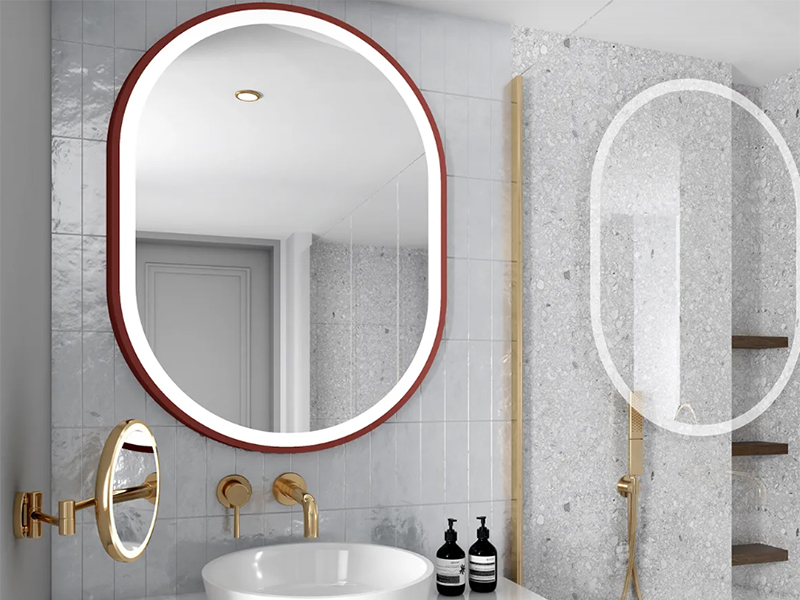

Why Cruise Ship Mirror Installation Requires Different Planning
Cruise ship mirror installation requires tighter coordination than a typical hotel or residential project. Cabins and bathrooms have limited working space, multiple trades often operate at the same time, and finished wall systems leave little room for adjustment.
Installation must also account for vessel movement, tight tolerances, electrical coordination, and restricted fit-out windows. On larger projects, the same mirror design may be repeated across hundreds of cabins, so even small installation errors can affect the wider programme.
For this reason, mirror installation should be planned as part of the overall cruise ship fit-out, with clear drawings, sequencing, tolerances, and handover requirements agreed in advance.
Start With a Site Survey and Approved Mirror Drawings
Before production or installation begins, confirm the mirror against the latest approved drawings and actual site conditions. Check the final mirror dimensions, finished wall position, vanity or basin centreline, nearby doors, cabinets, taps, shelves, lighting, electrical outlets, wall build-up, fixing locations, and required service clearance.
This early coordination helps prevent clashes, incorrect cable entry points, insufficient fixing support, and mirrors that cannot be removed later for maintenance.
Measure Finished Conditions, Not Just Design Dimensions
Custom mirrors offer very little scope for adjustment once manufactured. Where required, verify the finished wall opening and surrounding fixtures on site before final production rather than relying only on nominal drawing dimensions.
This is especially important where wall panels, joinery, vanities, or electrical positions may vary slightly from the original design.
Allow for Installation Tolerances
Cruise ship mirror installation should allow for differences between nominal drawing dimensions, manufacturing tolerances, finished wall tolerances, and the clearance needed for installation.
In practice, walls may not be perfectly plumb, panel joints may vary, and vanities, electrical outlets, ceilings, or adjacent furniture may sit slightly outside their intended positions. These small deviations can become critical when fitting a custom mirror into a confined cabin or bathroom.
For this reason, mirror dimensions and fixing positions should be coordinated against the vessel’s approved drawings and actual fit-out conditions, with sufficient installation clearance to avoid clashes or forced fitting.
Prepare the Substrate Before Mirror Installation
Before fitting the mirror, confirm that the wall panel or substrate is flat, clean, dry, and capable of supporting the specified mirror and fixing system. Check fixing zones, backing support, cable penetrations, finished surfaces, and the compatibility of any adhesive with both the mirror backing and wall material.
The fixing arrangement should be selected according to the mirror weight, wall construction, project specification, and future service requirements. No single fixing method is suitable for every vessel, so the installation detail should be coordinated with the approved marine fit-out design.
Select the Correct Mirror Fixing System
Cruise ship mirrors may use concealed brackets, mechanical fixings, clips, adhesive systems, mounting tapes, hybrid methods, or custom frames depending on the project.
The correct fixing system should be selected according to the mirror weight, substrate, expected vibration, available installation depth, maintenance access, removal requirements, and approved project specification. Adhesives and tapes must also be compatible with both the mirror backing and the mounting surface.
The fixing method should therefore be treated as a project-specific decision rather than a standard solution for every vessel.
Coordinate LED Mirrors With Electrical and Other Trades
LED mirror installation should be coordinated with the wider MEP and interior fit-out programme. Confirm the cable entry point, driver location, power supply, switching, dimming, demister connections, wiring route, and access requirements before the wall is closed.
The mirror position must also align with vanities, bathroom furniture, wall panels, lighting, plumbing, and joinery. Early coordination helps prevent clashes, inaccessible electrical components, or late modifications during installation.
Maintain Future Service Access
Installation should allow the mirror and its electrical components to be serviced or replaced without unnecessary damage to surrounding finishes. Check driver and wiring access, demister connections, nearby furniture, and the lift-off or removal clearance required for future maintenance.
Practical Coordination Checklist
Before installing an LED mirror, confirm:
- approved mirror position and dimensions
- final cable entry point
- power supply and voltage
- driver location and access
- switching and dimming requirements
- demister connection
- wiring route
- vanity and basin position
- wall panel and joinery interfaces
- nearby lighting and plumbing
- fixing zones and wall support
- required service and removal clearance
- wall closure status
- access for testing and commissioning
This checklist helps ensure the mirror can be installed, connected, tested, and later serviced without disrupting surrounding finishes.
Plan the Installation Sequence Within the Cruise Ship Fit-Out
Cruise ship mirror installation should be coordinated with the wider cabin or bathroom fit-out sequence. A typical installation process may include:
- Confirm the finished wall and surrounding surfaces.
- Verify the electrical first fix and cable position.
- Install the vanity or furniture where required.
- Recheck the final mirror opening and clearances.
- Mark the approved fixing locations.
- Install the mounting or fixing system.
- Connect the electrical components.
- Position and secure the mirror.
- Test the lighting, controls, and demister functions.
- Protect the finished mirror until handover.
The exact sequence will depend on the vessel, shipyard, cabin design, and overall fit-out programme. Because several trades may be working in the same area simultaneously, the mirror installation should be scheduled to avoid access conflicts, rework, or damage to completed finishes.
Manage Cabin-by-Cabin Mirror Installation
Large cruise projects may require similar mirror designs across hundreds of cabins, so clear identification and installation control are essential. Each mirror should be linked to the correct deck, cabin number, cabin type, mirror ID, and approved drawing or sample.
A simple identification format might be:
Deck 8 / Cabin Type B2 / Mirror Type M03
Packaging labels, installation drawings, variation records, and installation logs should use the same reference system throughout the project.
This reduces the risk of installing the wrong mirror, damaging finished interiors through unnecessary handling, losing time searching for the correct unit, or confusing similar mirror types across different cabin layouts.
Mirror Identification Workflow
A practical mirror identification workflow should remain consistent from production through installation:
1. Assign each mirror type a unique reference, such as `M01`, `M02`, or `M03`.
2. Link that reference to the approved drawing, cabin type, and project schedule.
3. Mark each finished mirror and its packaging with the mirror ID, deck, and cabin number where applicable.
4. Check the label against the installation drawing before the mirror is moved into the cabin.
5. Record any variation or replacement using the same reference system.
6. Update the installation log after the mirror has been fitted and inspected.
Using one identification system across drawings, packaging, logistics, and site installation helps maintain traceability and reduces errors during large-scale cabin rollouts.
Protect Installed Mirrors Until Handover
Mirror installation is not complete once the unit is fixed to the wall. It must remain protected and defect-free until final cabin handover.
Use suitable temporary protection or protective film where required, and prevent impact, construction debris, moisture, and aggressive cleaning chemicals from reaching the mirror surface, edges, or backing. Extra care is needed when other trades are still working nearby.
Protection should remain in place for as long as practical, but it should not interfere with testing, snagging, or final cleaning before handover.
Snagging and Commissioning LED Mirrors
Before handover, each LED mirror should be visually inspected, mechanically checked, and functionally tested. For repeated cabin installations, consistency between rooms is just as important as the performance of each individual mirror.
| Check | What to Confirm |
| Alignment and level | Mirror is correctly positioned, level, and aligned with the vanity or surrounding finishes |
| Gaps | Clearances are even and match the approved installation detail |
| Frame finish | No scratches, dents, coating defects, or colour variation |
| Mirror glass | No chips, cracks, scratches, or visible distortion |
| Edge quality | Edges are clean, finished, and free from damage |
| Mounting | Mirror is secure with no looseness or unwanted movement |
| LED lighting | All LEDs operate correctly with no flicker or dark sections |
| CCT consistency | Colour temperature is consistent across the mirror and between cabins |
| Dimming | Dimming operates smoothly where specified |
| Demister | Demister heats and functions correctly |
| Switches and sensors | Touch controls, sensors, or external switches operate as specified |
| Electrical connections | Connections are secure and correctly concealed |
| Visible cables | No exposed or poorly routed wiring remains |
| Surface finish | Mirror is clean and free from adhesive residue, fingerprints, or construction debris |
Any defects should be recorded against the relevant mirror ID and cabin number so they can be corrected before final commissioning and handover.
Plan for Future Mirror Replacement and Maintenance
Cruise ship mirror installation should also consider future servicing and replacement. The mirror should be removable without unnecessary damage to surrounding wall panels, joinery, or finishes, with sufficient access to LED drivers, wiring, demister connections, and other replaceable components.
Project records should retain the mirror ID, dimensions, finishes, electrical specification, and relevant drawing references. Keeping spare components where appropriate can also simplify maintenance and future replacement orders.
Working With Luma Mirrors on Cruise Ship Mirror Installation
Luma Mirrors by Gemm London supports cruise ship mirror projects from design development through to installation and handover, with a service built around the practical demands of marine fit-out.
Our team can coordinate drawings, samples, bespoke manufacturing, packaging, logistics, installation, and final handover support. This helps maintain consistency across repeated cabin types while reducing the risk of dimensional errors, installation delays, damaged finishes, and last-minute changes on board.
Luma works with shipyards, marine fit-out contractors, designers, and main contractors to align mirror production with cabin schedules, approved specifications, delivery sequencing, and restricted installation windows.
Send Luma your mirror schedule, cabin drawings, quantities, and project programme. Our team can review the installation requirements and develop a bespoke mirror solution for your cruise ship project.
