
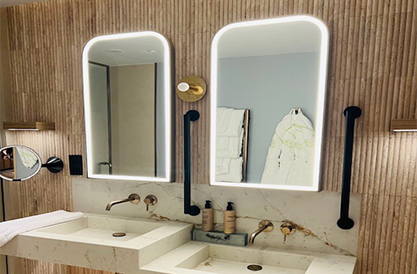
Why CRI Matters in Hotel Bathroom Lighting
In a hotel bathroom, lighting is one of the first things guests notice even if they don’t realise it. It affects how they see themselves in the mirror and how they perceive the space around them.
When colour rendering is poor, the impact is immediate. Skin tones can look flat or unnatural. Makeup applied under low-quality lighting often appears different in natural light. Even simple tasks like shaving can feel less precise.
These small frustrations quickly shape the overall impression of the room. Guests may not mention “CRI” in a review, but they will remember how the space made them feel whether it felt comfortable, flattering, and easy to use, or not.
In hospitality, lighting is not just a technical detail. It plays a direct role in guest satisfaction, perception of quality, and ultimately, how a hotel is experienced and reviewed.
What Is CRI (Colour Rendering Index)
CRI, or Colour Rendering Index, is a measure of how accurately a light source shows colours compared to natural daylight. In simple terms, it tells you how “true” colours will look under a specific type of lighting.
The scale runs from 0 to 100, with 100 representing natural sunlight , the benchmark for perfect colour accuracy. The closer a light source is to this level, the more natural and balanced colours will appear.
A higher CRI means colours look vivid and true to life. Skin tones appear natural, finishes look as intended, and details are easier to see. A lower CRI, on the other hand, can make colours look flat, washed out, or slightly distorted even if the space is bright enough.
For hotel bathroom mirrors, this difference is immediately noticeable. It affects not just how the space looks, but how comfortable and confident guests feel when using it.
CRI 80 vs 90 vs 95+: What’s the Difference
Not all LED lighting delivers the same level of colour accuracy. The difference between CRI 80, 90, and 95+ may seem small on paper, but in a hotel bathroom, it is immediately visible.
| CRI Level | Colour Accuracy | Visual Effect | Suitability for Hotel Bathrooms |
| CRI 80 | Acceptable | Colours appear slightly dull or muted | Not recommended for mirror lighting |
| CRI 90 | High | Colours look natural and balanced | Suitable for most hotel projects |
| CRI 95+ | Excellent | Colours appear vibrant and true to life | Ideal for premium and luxury hotels |
With CRI 80 lighting, the space may still feel bright, but colours lack depth. Skin tones can appear flat, and finishes may not look as intended.
At CRI 90, the difference becomes clear. Colours are more accurate, making everyday tasks like grooming and makeup application much easier and more reliable. This level is widely considered the baseline for hospitality environments.
CRI 95 and above takes this a step further. Colours appear richer and more precise, closely matching how they would look in natural daylight. For high-end hotel projects, this level of accuracy helps create a more refined and comfortable guest experience.
In practice, choosing the right CRI is less about brightness and more about quality. For hotel bathroom mirrors, CRI 90+ should be the minimum, while CRI 95+ delivers a noticeably more premium result.
How CRI Affects Guest Experience in Hotel Bathrooms
Grooming and Makeup Accuracy
Guests rely on bathroom mirrors for everyday routines, from shaving to applying makeup. When the lighting is not accurate, these tasks become more difficult.
Low CRI lighting can distort colours and reduce clarity, leading to uneven makeup or missed areas when shaving. What looks fine in the bathroom may appear completely different in natural light.
With high CRI lighting, colours are more accurate and details are clearer. This gives guests confidence that what they see in the mirror reflects how they will look outside the room.
Skin Tone Representation
Lighting has a direct effect on how skin tones appear.
High CRI lighting presents skin in a natural and balanced way, helping guests feel comfortable and at ease. It creates a more flattering and realistic reflection.
Low CRI lighting, on the other hand, can make skin look dull, washed out, or uneven. Even in a well-designed bathroom, this can negatively affect how the space is perceived.
Perceived Quality of the Room
Guests may not understand lighting specifications, but they immediately notice how a space feels.
Good lighting is often associated with quality, comfort, and attention to detail. When colours look right and the mirror is easy to use, the entire bathroom feels more premium.
Poor lighting has the opposite effect. Even in high-end hotels, low-quality light can make the space feel less refined or poorly considered. Over time, these small details influence guest satisfaction and overall impressions of the hotel.
CRI vs Colour Temperature: Understanding the Difference
CRI and colour temperature are often confused, but they serve very different roles in lighting design. Both are essential, especially in hotel bathroom mirrors.
CRI refers to colour accuracy that is how true colours appear under a light source.
Colour temperature, measured in Kelvin (K), describes the appearance of the light itself, from warm (yellow tones) to cool (bluish tones).
It’s possible to have the right colour temperature but still achieve poor results if the CRI is low.
For example:
- 4000K + low CRI → the light may look neutral, but colours will still appear flat or slightly off
- 4000K + high CRI → colours look natural, balanced, and true to life
This is why focusing on just one specification is not enough. In hotel bathrooms, both factors need to work together.
The goal is to combine a comfortable colour temperature with high colour accuracy, creating lighting that not only looks right but also performs well for everyday use.
Where CRI Matters Most in Hotel Bathroom Design
Mirror Lighting (Critical Zone)
The mirror is the most important area for high CRI lighting in any hotel bathroom. This is where guests interact with the space most closely, whether for grooming, makeup, or daily routines.
If colour accuracy is poor here, the impact is immediate. Details become harder to see, and results feel unreliable. High CRI lighting ensures that what guests see in the mirror is clear, natural, and consistent making the space far more usable.
Vanity and Sink Areas
Lighting around the vanity and sink supports task-focused activities. These areas require both clarity and consistency to function well.
Low CRI lighting can create uneven colour perception across the space, especially when combined with different light sources. High CRI helps maintain a uniform look, ensuring that colours and finishes appear the same from every angle.
Integrated Mirror Lighting Systems
Integrated LED mirror lighting is one of the most effective ways to achieve high CRI performance.
By incorporating lighting directly into the mirror, illumination is evenly distributed across the face. This reduces shadows, avoids harsh contrasts, and creates a more balanced lighting environment.
For hotel projects, this approach also improves consistency across rooms and simplifies installation, making it a practical and reliable solution at scale.
Common Mistakes Hotels Make with CRI Lighting
Even in well-designed hotel bathrooms, CRI is often overlooked during specification. The result is lighting that looks bright, but performs poorly in real use.
One of the most common mistakes is prioritising brightness over colour accuracy. A space may feel well lit, but if the CRI is low, colours will still appear flat or unnatural. Brightness alone cannot compensate for poor colour rendering.
Another issue is selecting CRI 80 lighting to reduce upfront costs. While this may seem efficient during procurement, it often leads to a noticeable drop in quality. Skin tones look less natural, and the overall space feels less refined especially when compared to higher-end competitors.
CRI is also frequently missing from lighting specifications altogether. Without clearly defined requirements, different suppliers may deliver inconsistent results, leading to variation across rooms or even within the same space.
Mixing different CRI levels is another common problem. When multiple light sources with varying colour accuracy are used together, the result is uneven lighting and visual inconsistency. This can make finishes appear different depending on where you stand in the room.
The outcome is a bathroom that feels inconsistent, less comfortable to use, and below the standard guests expect even if everything else in the design is well executed.
Why Integrated LED Mirror Lighting Delivers Better CRI Performance
Integrated LED mirror lighting is designed as a complete system, rather than something added on later. This makes a significant difference in how CRI performs in real hotel environments.
Because the lighting is built into the mirror, it delivers even illumination across the face, avoiding harsh shadows and uneven colour rendering. This ensures guests see consistent, natural tones every time they use the mirror.
It also improves consistency across rooms. In large hotel projects, maintaining the same lighting quality from one bathroom to another can be challenging. Integrated mirror systems help standardise output, ensuring a reliable experience throughout the property.
By incorporating lighting directly into the mirror, there is less dependence on external fixtures that may vary in quality or placement. The result is a cleaner design, better control over colour accuracy, and a more dependable lighting solution for hospitality environments.
Choosing the Right CRI LED Mirror for Your Hotel Project
Selecting the right mirror is not just about aesthetics, it’s about how the lighting performs in real use. A well-specified mirror can improve both functionality and guest experience across the entire project.
When evaluating options, there are a few key factors to consider.
CRI rating should be the starting point. For hotel bathrooms, CRI 90+ is the minimum standard, while higher levels deliver a more refined and accurate result.
Light distribution is equally important. Front-lit mirrors provide direct, task-focused illumination, while backlit designs create a softer ambient effect. In many cases, a combination of both offers the best balance between function and atmosphere.
Colour temperature options should align with the overall interior concept. Neutral tones are commonly preferred, but flexibility can help create the right mood for different hotel brands and room types.
Mirror size and placement also play a role in lighting performance. Larger mirrors or poorly positioned units can affect how evenly light is distributed across the face and surrounding space.
Finally, the mirror should be considered as part of the overall lighting design, not in isolation. Integration with the wider scheme ensures consistency, avoids conflicting light sources, and delivers a more cohesive result.
How Luma Mirror Approaches CRI LED Mirror Lighting for Hospitality Projects
Luma Mirrors by Gemm London approaches mirror lighting with a focus on performance, consistency, and real-world usability in hospitality environments.
Each solution is built using high-performance LED systems designed to deliver both strong brightness and accurate colour rendering. The goal is to ensure that lighting performs reliably across every room, not just in a sample setting.
Every project is fully bespoke. Mirrors can be tailored in terms of shape, size, and finishes, allowing them to align seamlessly with the interior design. Lighting configurations are also customised to suit the layout and functional requirements of each space.
Additional features can be integrated as needed, including demisters, DALI control systems, sensors, Bluetooth connectivity, and shaver sockets — all designed to enhance the guest experience without complicating the design.
Luma’s solutions are developed specifically for hotels, cruise ships, and large-scale residential developments, where consistency and reliability are critical.
The focus is always on delivering lighting that works as expected across the entire project combining design flexibility with dependable performance at scale.
If you’re specifying mirrors for a hotel project, considering CRI early helps avoid costly redesigns later.
Luma Mirror works closely with project teams to deliver bespoke mirror solutions that perform as expected — from concept through to installation.
