
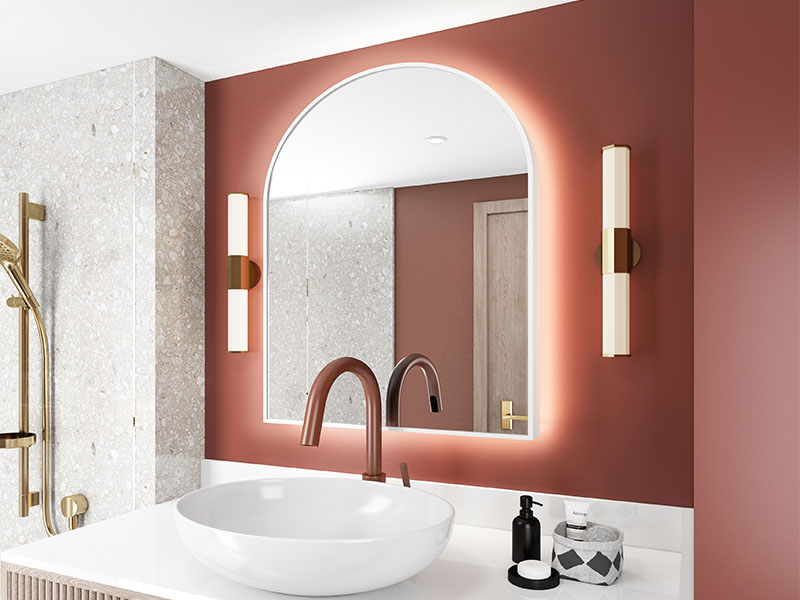
Choosing a backlit LED mirror for a commercial restroom is a technical specification decision, not a decorative choice. In high-use environments such as hotels, cruise ships, and public buildings, mirrors must perform reliably under constant humidity, cleaning, and daily use. Products without the right technical foundation quickly become maintenance liabilities.
A common mistake is using residential-grade mirrors in commercial restrooms. These are not designed for heavy use or moisture exposure, often leading to LED failure, condensation damage, inconsistent lighting, and higher lifecycle costs.
This guide explains how to choose a commercial LED backlit restroom mirror from a professional, practical perspective. It covers the key factors that affect performance, safety, durability, and long-term reliability, helping project teams make informed decisions that hold up in real-world commercial environments.
Step One: Confirm the Intended Use and Environment
Before evaluating lighting style, features, or finishes, the first and most important step in choosing a commercial LED backlit restroom mirror is to clearly define how and where the mirror will be used. Commercial restrooms place very different demands on mirrors compared to residential bathrooms, and misunderstanding the environment often leads to specification failures.
Frequency of Use and User Turnover
Commercial restrooms are designed for high-frequency, multi-user use. In hotels, cruise ships, offices, restaurants, and public venues, mirrors may be used hundreds of times per day by different users with varying habits.
This level of turnover affects:
- LED operating hours and expected lifespan
- Wear on electrical components and switches
- The need for consistent lighting performance throughout the day
A mirror that performs well in a low-use residential setting may degrade quickly when exposed to constant daily operation. Commercial backlit mirrors must be specified for continuous or extended-duty use, not intermittent residential patterns.
Humidity Levels and Exposure to Steam and Splashing
Commercial restrooms are moisture-intensive environments. Steam from handwashing, cleaning routines, and limited ventilation creates ongoing exposure to humidity, even when mirrors are not directly splashed with water.
Key environmental risks include:
- Condensation forming behind the mirror
- Moisture ingress into LED modules or wiring
- Corrosion of frames, fixings, and backing materials
This is why commercial projects require mirrors with appropriate IP ratings, sealed construction, and moisture-resistant substrates, rather than relying on visual placement alone to determine safety.
Size of the Restroom and Surrounding Lighting Conditions
The physical scale of the restroom and its existing lighting strategy directly influence mirror performance. In compact restrooms, backlit mirrors may contribute significantly to ambient lighting. In larger spaces, they often function as supplementary or accent lighting rather than the primary source.
Considerations include:
- Ceiling height and existing luminaire placement
- Wall finishes that reflect or absorb light
- Whether the mirror is expected to provide functional illumination or visual enhancement
Understanding the lighting context helps determine whether backlighting alone is sufficient or if additional light sources are required to meet usability expectations.
Why Commercial and Hospitality Environments Demand Higher Standards
Commercial and hospitality restrooms operate under higher expectations for safety, durability, and consistency. Failures are not only inconvenient but disruptive to operations and brand perception.
Compared to residential settings, commercial environments require:
- Higher electrical safety margins
- Greater tolerance to moisture and heat buildup
- Consistent performance across multiple installations
- Longer service life with reduced maintenance access
Confirming the intended use and environmental conditions at the outset ensures that every subsequent specification decision is grounded in real operational requirements, rather than assumptions based on appearance or residential norms.
Step Two: Evaluate Lighting Performance, Not Just Appearance
When specifying a commercial LED backlit restroom mirror, visual appeal alone is not a reliable indicator of performance. What looks impressive in a showroom or product photo may behave very differently once installed in a high-use, real-world environment. Lighting quality must be assessed in technical and practical terms, not just aesthetics.
Backlighting Brightness and Diffusion
Backlit mirrors rely on reflected light from the wall surface, which makes diffusion quality far more important than raw brightness.
Key performance criteria include:
- Even wall glow without hotspots, rings, or visible LED points
- Uniform light spread across the entire mirror perimeter
- Controlled brightness that enhances the space without overpowering it
Poor diffusion results in patchy illumination, visible bright zones, or uneven halos, all of which reduce perceived quality. In commercial restrooms, this inconsistency becomes more noticeable due to repeated exposure and varying ambient conditions.
Brightness must also be considered relative to restroom size and existing lighting. A backlit mirror intended to contribute to ambient lighting in a compact restroom requires a different output than one used purely as an architectural feature in a larger space.
Colour Rendering Index (CRI)
CRI is one of the most overlooked yet critical factors in commercial mirror lighting. It determines how accurately colours appear under artificial light.
For commercial and hospitality applications:
- CRI ninety or higher is strongly recommended
- Lower CRI lighting can distort skin tones, making them appear dull, grey, or unnatural
- Materials such as stone, tile, timber, and metal finishes lose depth and richness under low CRI light
CRI differences are especially noticeable in mirrors because guests view themselves at close range. Even subtle colour distortion can negatively affect grooming comfort and overall perception of cleanliness and quality. High CRI lighting supports visual confidence and reinforces a professional, well-considered environment.
Colour Temperature Selection
Colour temperature defines the visual mood of a restroom and must align with both function and design intent.
General guidelines include:
- Warm light for softer, more welcoming environments
- Neutral light for balanced clarity and versatility
- Cool light for crisp, modern interiors where precision is prioritised
In commercial settings, colour temperature must also be consistent across all installations. Variations between mirrors in adjacent restrooms or different areas of the same building create visual inconsistency that undermines brand standards.
Selecting the correct colour temperature is not just about preference. It must be coordinated with wall finishes, floor materials, and surrounding luminaires to ensure the backlit mirror integrates seamlessly into the overall lighting scheme.
Evaluating lighting performance at this level ensures the mirror delivers reliable visual quality, not just initial impact.
Step Three: Check Safety and IP Rating Requirements
In commercial restroom environments, electrical safety is not optional. LED backlit mirrors operate in areas where moisture, condensation, and cleaning routines are part of daily use. Verifying proper IP protection is therefore a fundamental step in the specification process, not a secondary consideration.
Why Moisture Protection Is Essential in Restroom Environments
Commercial restrooms are consistently exposed to:
- Steam from handwashing and cleaning
- Condensation caused by temperature changes
- Splashing water, even beyond basin areas
Unlike residential bathrooms, commercial spaces experience continuous exposure rather than occasional moisture. Over time, this increases the risk of electrical failure, corrosion, and performance degradation if the mirror is not properly protected.
Moisture ingress does not always occur from direct splashing. It often enters through cable entry points, backing boards, or poorly sealed LED channels, making construction quality just as important as rating labels.
Why IP44 Is Typically the Minimum Acceptable Rating
IP44 provides protection against:
- Solid objects larger than one millimetre
- Water splashes from any direction
For commercial restrooms, this level of protection is widely recognised as the minimum acceptable standard for LED mirrors installed near basins and wash areas. It offers a balance between safety, design flexibility, and lighting performance.
Mirrors rated below IP44, such as IP20 products, are not suitable for restroom environments, even if they are positioned away from direct water sources.
Why IP Compliance Applies to the Entire Mirror Assembly
A common mistake is assuming that IP protection applies only to the LED strips. In reality, IP compliance covers the complete mirror assembly, including:
- LED modules and drivers
- Internal wiring and connectors
- Backing boards and substrates
- Cable entry points and mounting interfaces
If any part of the system is inadequately protected, the IP rating is effectively compromised. True IP44 performance requires integrated design and proper sealing throughout the product.
Verifying Certification Rather Than Relying on Assumptions
Not all IP claims are equal. In commercial projects, it is essential to:
- Request formal test reports or certification
- Confirm that testing covers the complete mirror, not just components
- Verify that the rating applies to the intended installation orientation
Assuming compliance based on marketing descriptions exposes projects to unnecessary risk. Proper documentation ensures regulatory compliance, reduces liability, and supports long-term operational reliability.
By addressing safety and IP requirements early, professionals can avoid costly replacements, maintenance issues, and potential compliance failures later in the project lifecycle.
Step Four: Assess Construction and Durability
In commercial restrooms, durability is as important as lighting performance. Backlit LED mirrors are subjected to constant use, frequent cleaning, humidity, and temperature variation. Construction quality determines whether a mirror performs reliably for years or becomes a recurring maintenance issue.
Sealed LED Modules and Protected Internal Wiring
High-quality commercial mirrors use fully sealed LED modules with protected internal wiring. This prevents moisture ingress into electrical components, reduces the risk of short circuits, and maintains stable lighting output over time. Poorly sealed systems may function initially but often fail prematurely as humidity penetrates connectors and drivers.
Attention should also be given to how wiring is routed and secured within the mirror assembly. Loose or exposed cabling increases the likelihood of vibration damage and electrical faults in high-use environments.
Moisture-Resistant Backing Materials
The backing board is one of the most overlooked elements of mirror construction. In commercial restrooms, standard MDF or untreated substrates can absorb moisture, swell, and degrade. Hospitality-grade mirrors use moisture-resistant backing materials that remain dimensionally stable even under prolonged exposure to humidity.
A robust backing system also supports safe mounting and helps maintain the integrity of seals and fixings throughout the mirror’s service life.
Corrosion-Resistant Frames and Fixings
Frames, brackets, and fixings are continuously exposed to moisture and cleaning chemicals. Corrosion-resistant materials such as anodised aluminium, stainless steel, or treated composites are essential in commercial restroom installations.
Inferior metals may corrode over time, leading to structural weakness, visual degradation, and difficulty during maintenance or replacement.
Heat Management Within Sealed Mirror Systems
Backlit mirrors generate heat, particularly within sealed IP-rated assemblies. Effective heat management is critical to:
- Protect LED lifespan
- Maintain consistent brightness
- Prevent colour shift over time
Well-engineered mirrors incorporate thermal management strategies that dissipate heat without compromising moisture protection. Poor heat control accelerates LED degradation and increases the likelihood of driver failure.
How Build Quality Affects Lifespan and Maintenance Costs
Construction quality directly impacts:
- Product lifespan
- Frequency of maintenance or replacement
- Downtime in operational restrooms
- Total cost of ownership over the project lifecycle
In commercial environments, investing in durable construction reduces long-term costs and ensures consistent performance across multiple restroom installations. Assessing build quality early allows professionals to avoid hidden liabilities that only emerge after installation.
Step Five: Select the Correct Size, Shape, and Proportion
In commercial restroom design, mirror selection is driven by proportion and usability rather than visual trends. The correct size and shape ensure functional comfort, visual balance, and consistency across multiple installations, which is essential in commercial and hospitality projects.
Mirror Width Relative to Basin and Wall Dimensions
Mirror width should be carefully aligned with the basin or vanity below. As a general guideline, the mirror should match or slightly undercut the width of the basin to maintain visual order and avoid awkward overhangs. In multi-basin restrooms, consistent mirror widths create rhythm and clarity, supporting efficient use of space.
Oversized mirrors may dominate the wall and reflect unwanted visual clutter, while undersized mirrors can feel inadequate and diminish the perceived quality of the restroom.
Height Considerations for Accessibility and Usability
Height selection must accommodate a wide range of users. The mirror should provide clear visibility for both standing and seated users, taking into account accessibility requirements and inclusive design principles. In commercial restrooms, mirrors are typically positioned higher than residential installations to improve sightlines and reduce splash exposure at the lower edge.
Correct height placement also contributes to ease of cleaning and long-term durability.
Choosing Shapes Based on Repetition and Consistency Rather Than Trends
While shaped mirrors may be visually appealing, commercial projects benefit from forms that can be repeated consistently across multiple locations. Rectangular, softly rounded, or circular mirrors often perform best because they integrate easily into standardised layouts and allow for efficient manufacturing and installation.
Highly bespoke or irregular shapes can complicate alignment, lighting consistency, and future replacement, particularly in large-scale restroom programmes.
Why Proportion Matters More Than Decorative Styling in Commercial Projects
In commercial environments, proportion communicates quality more effectively than decorative detail. Mirrors that are well-scaled to the space feel intentional, professional, and durable. Poorly proportioned mirrors, regardless of finish or lighting quality, can make even well-designed restrooms feel unbalanced or compromised.
Focusing on size, shape, and proportion ensures the mirror supports the overall function of the space while maintaining long-term consistency across the project.
Step Six: Plan Installation and Electrical Integration
Proper installation and electrical integration are critical to the performance and safety of commercial LED backlit restroom mirrors. Even a well-specified mirror can fail prematurely if installation requirements are not considered from the outset.
Hardwired Versus Plug-In Backlit Mirrors in Commercial Settings
In commercial restrooms, hardwired mirrors are generally preferred. Hardwiring improves electrical safety, reduces tampering risk, and creates a cleaner visual result with no exposed cables or sockets. It also supports integration with building management systems and lighting controls.
Plug-in mirrors may offer short-term flexibility in limited refurbishment scenarios, but they are rarely suitable for high-traffic commercial restrooms where durability, security, and code compliance are priorities.
Wall Preparation and Waterproofing Coordination
Wall construction and waterproofing must be coordinated before mirror installation. Uneven surfaces, inadequate waterproof membranes, or poorly finished tile edges can compromise mounting stability and allow moisture to reach electrical components.
The mirror supplier, installer, and contractor should align early to confirm fixing points, load requirements, and waterproofing details to avoid retroactive adjustments on site.
Cable Routing and Access for Maintenance
Cable routing should be planned to protect wiring from moisture while allowing future access for inspection or servicing. Inaccessible or buried connections increase maintenance complexity and may require wall removal if issues arise.
Well-designed installations include discreet access points that preserve IP protection while enabling long-term serviceability.
How Poor Installation Compromises IP Performance and Durability
An IP44-rated mirror can lose its protective integrity if installation is poorly executed. Incorrect sealing, damaged gaskets, or improper cable entry can allow moisture ingress, leading to flicker, corrosion, or electrical failure.
In commercial projects, installation quality is as important as product specification. Professional electrical installation ensures the mirror performs safely, consistently, and reliably throughout its service life.
Step Seven: Decide Which Smart Features Add Real Value
Smart features can enhance the functionality of a commercial backlit restroom mirror, but only when they serve a clear operational or user benefit. In commercial environments, technology should improve reliability, safety, and efficiency, not introduce unnecessary complexity.
Demisters for Consistent Clarity in Humid Environments
Demisters are one of the most valuable smart features in commercial restrooms. They maintain a clear mirror surface during periods of high humidity, supporting hygiene, usability, and a consistently professional appearance. In high-traffic restrooms, demisters reduce guest frustration and eliminate the need for frequent manual wiping by maintenance staff.
Motion Sensors for Safety and Energy Management
Motion or presence sensors can be used to activate lighting automatically when users enter the restroom. This improves visibility, particularly in low-light conditions, while reducing unnecessary energy consumption when the space is unoccupied. In commercial settings, automated activation also minimises touchpoints, supporting hygiene standards.
Integration With Lighting Control Systems
Integration with central lighting or building management systems allows mirrors to operate in harmony with the overall lighting strategy. This can support scheduled dimming, occupancy-based control, and energy optimisation across large facilities. For commercial projects, compatibility with control systems should be planned early to avoid retrofit challenges.
Avoiding Unnecessary Features That Increase Failure Risk
Not all smart features add value in commercial restrooms. Overly complex interfaces, entertainment functions, or non-essential connectivity can increase the risk of malfunction and complicate maintenance. The most effective specifications prioritise features that are intuitive, robust, and relevant to the environment.
Selecting smart functions with purpose ensures the mirror remains reliable, easy to maintain, and aligned with the practical demands of commercial restroom use.
Step Eight: Evaluate the Supplier’s Capability
Selecting the right supplier is as important as selecting the right product. A commercial backlit restroom mirror should be supported by technical expertise, documentation, and long-term service capability.
Ability to Provide Test Reports and Technical Documentation
Suppliers should be able to supply verified documentation covering IP ratings, electrical safety, CRI performance, and LED lifespan. Transparent data reduces risk and supports compliance with commercial project requirements.
Experience With Commercial or Hospitality Restroom Projects
Suppliers experienced in commercial or hospitality environments understand the demands of high-traffic use, moisture exposure, and consistency across large installations. This experience translates into better product design, clearer communication, and fewer issues during installation.
Support With CAD Drawings and Technical Coordination
Technical coordination is critical in commercial projects. The ability to provide CAD drawings, fixing details, and electrical layouts helps contractors integrate mirrors smoothly into wall systems, waterproofing, and lighting plans.
Logistics, Aftercare, and Long-Term Support
Commercial projects require reliable logistics, clear lead times, and ongoing support after installation. Access to spare parts, consistent product lines, and responsive aftercare ensures mirrors remain operational and visually consistent throughout their service life.
Evaluating supplier capability alongside product specification helps ensure the project performs as intended, both on opening day and years into operation.
Common Mistakes to Avoid When Choosing Commercial LED Backlit Restroom Mirrors
Even experienced project teams can encounter issues if commercial LED backlit mirrors are specified without a full understanding of performance and operational requirements. Avoiding the following mistakes helps reduce risk and ensures long-term reliability.
Assuming Backlighting Alone Provides Sufficient Illumination
Backlit mirrors are primarily designed to create ambient wall glow rather than direct task lighting. Assuming they can fully replace functional lighting often leads to poor grooming visibility and guest dissatisfaction. In many commercial restrooms, backlighting should be part of a layered lighting approach rather than the sole light source.
Selecting Residential-Grade Mirrors for Commercial Use
Residential mirrors are not engineered for high-frequency use, prolonged humidity exposure, or intensive cleaning routines. Installing residential-grade products in commercial restrooms frequently results in early LED failure, moisture damage, and increased maintenance costs.
Ignoring IP Ratings and Certification
Failing to verify IP ratings and certification is a common and costly oversight. Without proper moisture protection, electrical components are vulnerable to condensation and splashing. Always confirm that IP compliance applies to the complete mirror assembly and is supported by test documentation.
Prioritising Cost Over Performance and Durability
Lower upfront cost often comes at the expense of build quality, lighting performance, and lifespan. In commercial settings, this can lead to higher lifecycle costs through frequent repairs, replacements, and downtime. Performance and durability should always take precedence over short-term savings.
Failing to Plan for Maintenance Access
Mirrors that cannot be serviced without wall removal create unnecessary operational disruption. Lack of access to drivers, wiring, or control components complicates maintenance and increases long-term costs. Serviceability should be considered at the specification stage.
Conclusion: Making an Informed Specification Decision
Choosing a commercial LED backlit restroom mirror is a technical decision that directly affects safety, performance, and operational efficiency.
Why Choosing Correctly Reduces Risk and Lifecycle Costs
Proper specification minimises electrical risk, reduces premature failures, and lowers maintenance demands over time. This leads to predictable performance and better control of long-term costs.
Importance of a System-Based Approach
Commercial mirrors should be evaluated as complete systems, combining lighting performance, IP protection, construction quality, installation method, and smart integration. Treating the mirror as a standalone decorative item increases the likelihood of failure.
How Proper Selection Improves Performance, Safety, and Longevity
When lighting quality, moisture protection, durability, and consistency are addressed together, backlit mirrors deliver reliable performance and maintain their appearance throughout years of commercial use. An informed, professional approach ensures the mirror supports the restroom environment rather than becoming a point of failure.
Ready to specify commercial backlit LED mirrors with confidence?
Partner with Luma Mirrors by Gemm London to design, manufacture, and install hospitality-grade LED mirror solutions built for real-world commercial use. From lighting performance and IP compliance to durability and consistency at scale, our team supports you at every stage — from early design and CAD coordination through installation and certification.
Contact Luma Mirrors today to discuss your project requirements and create a backlit mirror solution tailored to your restroom environment, technical standards, and long-term performance goals.
