
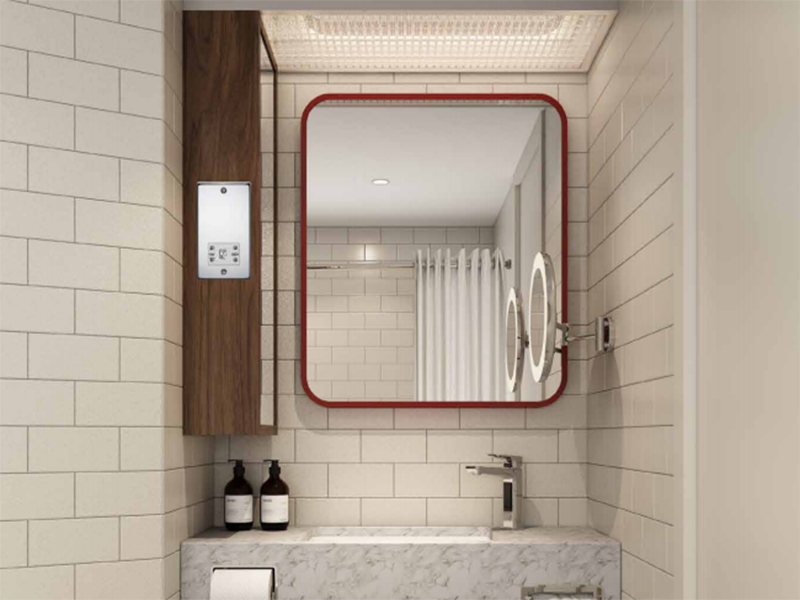

Why Material Selection Matters for Cruise Ship Mirrors
Cruise ship mirrors operate in a more demanding environment than mirrors installed in standard residential or hotel bathrooms. High humidity, condensation, frequent cleaning, vibration, and potential exposure to salt-laden air can all affect the long-term appearance and performance of the mirror and its surrounding components.
Humidity is particularly important. In marine and other high-moisture environments, conventional mirrors can develop corrosion around the edges or reflective backing over time. Specialist anti-corrosion mirror products are therefore often recommended for cruise ship bathrooms, spas, and other humid onboard spaces.
However, choosing materials for a cruise ship mirror involves much more than selecting corrosion-resistant glass. The frame, backing, edge protection, fixings, coatings, LED profiles, and component housings all form part of the complete mirror assembly. If one material is unsuitable for its environment, it can shorten the service life of the whole product.
Material selection can also affect several other project requirements:
- Weight: Lightweight materials can be advantageous for large mirrors and repeated installations across hundreds of cabins.
- Durability: Materials and finishes must withstand moisture, regular cleaning, and long periods of use.
- Corrosion resistance: Frames, fasteners, coatings, and mirror backing should be appropriate for the level of marine exposure.
- Appearance: Luxury cabins, suites, and public areas may require specific metallic finishes, colours, or decorative details.
- Maintenance: Materials should be easy to clean, inspect, repair, or replace throughout the vessel’s operating life.
- Cost: The highest-grade material is not necessarily required for every component or every location onboard.
The correct specification therefore depends on where the mirror will be installed and how severe the local environment is. A mirror in a climate-controlled guest bedroom has different requirements from one installed in a humid cabin bathroom, spa, public washroom, or area close to an exterior deck.
For designers, specifiers, shipyards, and marine fit-out contractors, the objective should be to select materials as a complete system rather than considering the mirror glass, frame, and fixings independently. This helps achieve the right balance between corrosion resistance, weight, appearance, durability, maintainability, and project cost.
Choosing the Right Mirror Glass
The mirror glass is one of the most important material decisions in a cruise ship mirror because humidity, condensation, cleaning chemicals, and long service periods can gradually affect the reflective coating behind the glass.
A conventional mirror is typically produced by applying a reflective silver layer to glass and then protecting that layer with additional backing materials. Traditional mirror constructions may also use copper and protective paint layers behind the silver.
For cruise ship projects, the best choice depends on the installation location and expected exposure. A mirror in a climate-controlled guest bedroom may have different requirements from one installed in a cabin bathroom, spa, or other consistently humid area.
Standard Silvered Mirror
A standard silvered mirror uses a reflective silver coating applied to the back of clear glass, with protective layers added behind it.
This type of mirror can be suitable for many interior applications where environmental conditions are controlled and the backing and edges remain adequately protected. However, prolonged exposure to excessive humidity can eventually affect the reflective coating, often appearing as black spots or deterioration around the mirror edges.
For cruise ship applications, standard silvered mirror may therefore be considered for locations with relatively low moisture exposure, provided that:
- the mirror backing is properly protected;
- exposed edges are correctly detailed;
- installation does not allow moisture to remain trapped behind the mirror;
- cleaning products are compatible with the mirror construction; and
- the product meets the project’s safety and performance requirements.
The lowest-cost mirror glass should not automatically be selected simply because the mirror is installed indoors. The actual humidity level and installation environment should determine whether a standard mirror is appropriate.
Copper-Free Mirror
A copper-free mirror uses an alternative protective system that eliminates the copper layer traditionally used behind the reflective silver coating.
Modern copper-free mirror products can offer improved resistance to atmospheric corrosion while also reducing the use of copper and lead within the manufacturing process. For example, Pilkington’s Optimirror range is manufactured without copper and lead and is designed to provide improved protection of the reflective silver layer and greater resistance to natural atmospheric corrosion.
These characteristics can make copper-free mirrors attractive for applications such as:
- cruise ship cabin bathrooms;
- hotel-style vanity areas onboard;
- public washrooms;
- other interiors exposed to regular humidity and condensation.
However, “copper-free” should not be treated as an automatic guarantee that a mirror is suitable for every marine environment. The complete construction still matters, including the protective backing, edge condition, installation method, ventilation, and level of exposure.
Designers and specifiers should therefore review the actual corrosion performance and technical documentation of the proposed mirror rather than relying on the term copper-free alone.
Anti-Corrosion Mirror Products
Where mirrors are exposed to consistently high humidity or more demanding marine conditions, a dedicated anti-corrosion mirror product may be more appropriate.
These products use specially developed coatings or reflective systems intended to resist deterioration in environments where conventional mirrors may have a shorter service life.
Pilkington, for example, specifically recommends anti-corrosive mirrors for humid areas aboard cruise ships, including bathrooms and spas, noting that conventional glass and mirrors can deteriorate more rapidly in these conditions.
Anti-corrosion mirror products can be particularly relevant for:
- cabin bathrooms with frequent condensation;
- spas and wellness areas;
- public washrooms;
- mirrors closer to exterior areas;
- locations with persistent humidity;
- refurbishment projects where improving service life is a priority.
They may carry a higher initial material cost than a conventional mirror, but that should be assessed against the potential cost and disruption of premature replacement once a vessel is in service.
For most cruise ship projects, the decision should therefore not simply be standard mirror versus premium mirror. The better approach is to match the glass specification to the actual onboard environment.
| Mirror Type | Typical Suitability | Main Consideration |
| Standard silvered mirror | Controlled interior locations | Adequate protection from prolonged humidity |
| Copper-free mirror | Bathrooms and other moderately humid interiors | Improved corrosion resistance depends on complete product construction |
| Anti-corrosion mirror | High-humidity or demanding marine locations | Greater protection where conventional mirrors may deteriorate |
The mirror glass should also be considered together with the frame, backing, edge protection, and fixing materials. A high-performance mirror product can still experience problems if surrounding components or installation details allow moisture to attack vulnerable areas.
Choosing the Right Frame Material
The frame has both a visual and technical role in a cruise ship mirror. It defines the appearance of the finished product, supports the mirror assembly, and may also carry LED profiles, decorative finishes, or concealed fixing details.
For most bespoke cruise ship mirrors, aluminium and stainless steel are the two main frame materials worth considering. Both can perform well in marine applications, but the correct choice depends on the installation location, required finish, overall mirror size, weight target, and level of chloride exposure.
Aluminium vs Stainless Steel
Aluminium is often attractive for cruise ship mirror frames because it combines low weight, good corrosion resistance, easy fabrication, and a wide choice of decorative finishes. This can be particularly useful for large mirrors or repeated installations across hundreds of cabins where unnecessary weight should be avoided.
Stainless steel provides a different set of advantages. It offers a premium metallic appearance, good mechanical durability, and—when the correct grade is selected—strong resistance to corrosion in chloride-containing environments.
| Factor | Aluminium | Stainless Steel |
| Weight | Lightweight | Heavier |
| Corrosion resistance | Good when the correct alloy and finish are used | Very good to excellent depending on grade |
| Decorative finishes | Anodised, powder-coated and other coloured finishes | Brushed, polished, satin and decorative metallic finishes |
| Fabrication | Well suited to extrusion and lightweight frame profiles | Well suited to fabricated and formed frames |
| Large-format mirrors | Particularly useful where weight reduction is important | Suitable where additional weight is acceptable |
| Chloride resistance | Depends on alloy, finish and exposure | Strongly dependent on stainless steel grade |
| Maintenance | Generally straightforward with an appropriate finish | Surface cleanliness and finish quality remain important |
| Typical design character | Lightweight, flexible, contemporary | Premium, substantial metallic appearance |
Neither material should be selected only by appearance.
For example, a powder-coated aluminium frame may be an excellent choice for a mirror in a guest cabin bathroom, while a stainless steel frame may be preferred for a project requiring an exposed brushed-metal finish or greater resistance to a more aggressive environment.
The most important question is therefore not simply “aluminium or stainless steel?”, but:
Which alloy or grade, surface finish, and construction are appropriate for the mirror’s actual location onboard?
Stainless Steel Grades for Marine Applications
The term stainless steel covers many different grades, and their resistance to chloride-induced corrosion varies considerably.
Two of the most familiar grades are 304 and 316 stainless steel.
304 stainless steel provides good corrosion resistance in many normal interior and architectural environments. However, chloride-rich conditions increase the risk of pitting and crevice corrosion, so 304 should not automatically be treated as suitable for every marine location.
316 stainless steel contains molybdenum, which gives it greater resistance than 304 to pitting and crevice corrosion in chloride-containing environments. For this reason, 316 is commonly specified for marine fittings and other applications exposed to more aggressive conditions.
However, this does not mean that every cruise ship mirror frame must automatically use 316 stainless steel.
A mirror installed in a climate-controlled guest bedroom is exposed to very different conditions from a frame located near an exterior deck, spa, or persistently humid area. Appropriate grade selection should therefore consider:
- distance from direct salt exposure;
- humidity and condensation;
- frequency of cleaning;
- whether the frame is continuously wet or normally dry;
- surface finish;
- accessibility for maintenance;
- design life; and
- project-specific marine requirements.
In more aggressive marine or coastal conditions, grades with greater corrosion resistance than 316 may sometimes be required. Stainless steel selection guidance therefore bases grade choice on the severity of the environment rather than using one universal grade for all marine applications.
Surface condition also matters. Smooth, clean stainless steel surfaces generally resist corrosion better than rough surfaces, which can retain salt, moisture, and other contaminants. Post-fabrication processes such as passivation can also help restore the protective passive surface after manufacturing.
For cruise ship mirrors, the stainless steel specification should therefore identify not only the grade, but also the required finish and fabrication quality.
Aluminium Grades and Finishes
Aluminium is widely used in marine applications because of its favourable combination of low density, corrosion resistance, manufacturability, and strength.
However, as with stainless steel, not every aluminium alloy performs in exactly the same way.
The 5xxx series aluminium-magnesium alloys are particularly well known for corrosion resistance in marine environments. The Aluminum Association identifies alloys in this group as having good weldability and resistance to marine corrosion, with 5083 being a recognised marine alloy.
Alloy 5083, for example, is widely associated with demanding marine applications because it combines relatively high strength with good seawater corrosion resistance. However, it is more commonly encountered in plate and sheet applications than in decorative mirror-frame extrusion profiles.
This distinction matters for cruise ship mirrors.
A structural marine alloy is not automatically the best choice for a decorative extruded frame. Mirror frames may place greater emphasis on:
- extrusion quality;
- surface appearance;
- dimensional precision;
- ease of fabrication;
- anodising quality;
- powder-coating performance; and
- required corrosion resistance.
The finish applied to the aluminium is therefore as important as the base alloy.
Common options include:
Anodising
Creates a controlled oxide layer on the aluminium surface and can provide a durable metallic finish in colours such as natural silver, bronze, black, or other project-specific tones.
Powder coating
Provides a wide range of colours and decorative finishes while adding a protective coating over the aluminium substrate.
Decorative metallic finishes
Can be used where designers need the visual effect of bronze, brass, black metal, or other finishes without the weight associated with some alternative materials.
For marine projects, designers should consider not only the desired colour but also the coating specification, pretreatment, edge coverage, fabrication process, and expected exposure.
A high-quality aluminium frame with the correct alloy and finish can therefore be an excellent solution for cruise ship mirrors, particularly where weight reduction, bespoke profiles, and finish flexibility are important.
Ultimately, both aluminium and stainless steel can be suitable. The best frame specification is the one that balances corrosion resistance, weight, fabrication, appearance, maintenance, and cost for the particular onboard location.
Why Surface Finishes and Coatings Matter
Selecting the correct aluminium alloy or stainless steel grade is only part of the material specification. In a cruise ship environment, the surface finish and protective coating can have a major influence on corrosion resistance, appearance, cleanability, and long-term durability.
A poorly finished metal can deteriorate faster than a correctly treated material of the same grade. For this reason, designers and specifiers should consider the base material and its surface treatment as one complete specification.
Aluminium Finishes
For aluminium mirror frames, the two most common finishing approaches are anodising and powder coating.
Anodising creates a controlled oxide layer on the aluminium surface. This can improve corrosion resistance while retaining a metallic appearance. It is often used where designers want finishes such as natural aluminium, bronze, black, or other architectural tones.
Powder coating applies a protective decorative coating over the aluminium. It offers a much wider colour range and can be useful when the mirror frame needs to coordinate with bathroom fittings, cabinetry, or the wider cabin interior.
For cruise ship applications, the specification should consider more than colour alone. Important factors include:
- surface pretreatment;
- coating thickness;
- adhesion;
- edge coverage;
- resistance to humidity and cleaning chemicals;
- expected chloride exposure; and
- repairability if the finish is damaged.
Any machining, cutting, or fabrication completed after finishing can expose untreated aluminium, so the manufacturing sequence should also be controlled.
Stainless Steel Finishes
Stainless steel relies on a thin passive oxide layer for its corrosion resistance, but the quality and smoothness of the finished surface still matter.
Rougher surfaces can retain moisture, salt deposits, and contaminants more easily, increasing the risk of staining or localised corrosion. Smoother finishes are generally easier to clean and better suited to demanding coastal or marine environments.
Common finishes for mirror frames include:
- brushed;
- satin;
- polished;
- mirror-polished; and
- decorative coated finishes.
The chosen finish should balance corrosion performance with the visual requirements of the interior design.
Passivation After Fabrication
Fabrication processes such as cutting, welding, grinding, or handling can introduce contaminants onto stainless steel surfaces.
Passivation is a chemical treatment used to remove free iron and other surface contamination and help restore the stainless steel’s protective passive layer after fabrication.
For fabricated cruise ship mirror frames, post-fabrication cleaning and passivation may therefore be relevant, particularly where the stainless steel will be exposed to more demanding humidity or chloride conditions.
Decorative Coatings Must Also Be Durable
Cruise ship interiors often require decorative finishes such as:
- brushed bronze;
- champagne gold;
- black;
- brass-effect;
- satin silver; or
- other project-specific colours.
The visual finish should not be specified independently from its performance.
For example, a decorative coating may look correct during sample approval but still perform poorly if it is unsuitable for repeated cleaning, humidity, or the expected marine environment. Designers should therefore request appropriate technical information and, where necessary, approve physical samples or mock-ups before production.
Finish Quality Can Affect Maintenance
Surface finish also influences how easily the frame can be maintained during the vessel’s operating life.
Smooth, durable finishes are generally easier to clean and less likely to retain dirt, cleaning residues, or salt deposits. This is especially important in:
- cabin bathrooms;
- spas;
- public washrooms;
- high-use guest areas; and
- locations closer to exterior spaces.
The best finish is therefore not necessarily the most decorative or the most expensive. It is the one that delivers the required appearance, corrosion resistance, cleanability, and service life for the specific onboard location.
For cruise ship mirrors, the material specification should always define both the base material and the required finish. Terms such as “aluminium frame” or “stainless steel frame” are often too broad on their own to ensure consistent long-term performance.
Choosing Materials for the Complete Mirror Assembly
A cruise ship mirror should not be specified by looking only at the visible glass and frame. The backing, edge protection, fixings, LED profiles, and electrical housings also affect durability, corrosion resistance, maintenance, and long-term performance.
This is particularly important in marine interiors because moisture can reach concealed areas behind the mirror, while vibration and repeated cleaning can place additional stress on the complete assembly.
Mirror Backing and Edge Protection
The reflective coating on the rear of a mirror is one of its most vulnerable areas. If moisture or cleaning chemicals reach this layer, the mirror can begin to deteriorate, often appearing as dark spots or corrosion around the edges.
For cruise ship applications, the backing system should therefore be selected to provide appropriate protection against humidity and condensation.
Key considerations include:
- protective backing coatings;
- safety backing film where required;
- moisture resistance;
- compatibility with adhesives and mounting systems;
- protection around cut-outs and processed edges; and
- correct detailing to prevent water from becoming trapped behind the mirror.
Edge protection is particularly important because deterioration often begins at exposed or poorly protected edges.
Where the mirror includes drilled holes, notches, sensor cut-outs, or shaped edges, these areas should receive the same attention as the main perimeter. The fabrication and installation process should avoid damaging the protective backing or leaving vulnerable areas exposed to moisture.
Safety backing may also be specified where the project requires broken mirror fragments to remain attached to the backing material rather than falling freely.
Fixings and Fasteners
Fixings must provide enough strength to secure the mirror under normal operation while also accounting for vibration, vessel movement, humidity, and long-term maintenance.
Depending on the mirror design, fixing components may include:
- stainless steel screws;
- brackets;
- aluminium rails;
- concealed mounting systems;
- clips;
- mechanical retainers; and
- approved adhesives or tapes.
The fixing material should be compatible with both the mirror frame and the surrounding substrate.
This is especially important where different metals are used together. When dissimilar metals remain in contact in the presence of moisture, galvanic corrosion can occur. For example, an aluminium component directly connected to a more noble metal in a wet environment may corrode more rapidly unless the materials are properly isolated or protected.
For this reason, designers and manufacturers should consider:
- metal compatibility;
- isolating washers or coatings where required;
- suitable fastener grades;
- moisture exposure;
- accessibility for replacement; and
- whether the fixing system allows controlled removal during future maintenance.
The exact fixing method should ultimately be coordinated with the shipyard or marine fit-out contractor and the substrate onto which the mirror will be installed.
LED Profiles and Electrical Component Housings
For illuminated mirrors, the material specification extends into the lighting system.
Aluminium is commonly used for LED profiles because it is lightweight, easy to fabricate, and helps dissipate heat produced by the LED strip. Effective heat dissipation can support more stable LED performance and contribute to longer component life.
The profile itself may also form part of the visible design, so both corrosion resistance and finish quality should be considered.
Electrical component housings may contain:
- LED drivers;
- connectors;
- sensors;
- switches;
- dimming components; and
- demister controls.
The housing material must be suitable for the installation environment and should provide appropriate protection from moisture, heat, and accidental contact.
Common housing materials can include:
- coated aluminium;
- stainless steel;
- other coated metals; and
- engineered plastics.
Material selection should consider:
- corrosion resistance;
- heat dissipation;
- electrical insulation;
- enclosure protection;
- accessibility for servicing; and
- compatibility with the mirror’s overall construction.
For cruise ship bathrooms and other humid areas, electrical components should also be coordinated with the required IP rating and project electrical specification.
The important point is that every element of the mirror should work as part of one coordinated system. A high-quality frame and mirror glass can still suffer premature failure if the backing, fasteners, LED profiles, or component housings are unsuitable for the environment.
For this reason, cruise ship mirror specifications should evaluate the complete assembly rather than isolated components.
How Location on the Ship Changes Material Requirements
There is no single material specification that is suitable for every mirror on a cruise ship. The correct choice depends heavily on where the mirror is installed and the conditions it will experience during operation.
A mirror in a climate-controlled guest bedroom may face relatively mild conditions, while one installed in a cabin bathroom, spa, public washroom, or near an exterior area may be exposed to significantly more humidity, condensation, cleaning chemicals, or chloride-laden air.
For this reason, material selection should be based on the actual exposure level of each onboard location rather than applying the highest marine specification to every mirror.
| Onboard Location | Typical Conditions | Main Material Priorities |
| Guest cabin bedroom | Climate-controlled, relatively dry | Appearance, low weight, finish quality, durability |
| Cabin bathroom | High humidity, condensation, frequent cleaning | Corrosion resistance, protected backing, edge durability |
| Public washroom | High usage, repeated cleaning | Durability, cleanability, robust finishes |
| Spa and wellness area | Persistent humidity and moisture | Enhanced corrosion resistance, moisture protection |
| Suite or premium cabin | Controlled environment with high design expectations | Decorative finish, appearance, durability |
| Crew accommodation | Frequent use and practical maintenance requirements | Robustness, serviceability, cost efficiency |
| Area close to exterior deck | Greater potential exposure to salt-laden air | Higher corrosion resistance, suitable metal grades and finishes |
Guest Bedrooms and Dressing Areas
Mirrors installed in guest bedrooms or dressing areas are generally exposed to less moisture than bathroom mirrors.
Material priorities may therefore shift toward:
- lightweight construction;
- decorative finishes;
- visual consistency with cabin furniture;
- LED lighting performance; and
- ease of installation.
A well-finished aluminium frame, for example, may provide an effective balance of low weight, design flexibility, and durability in these locations.
Cabin Bathrooms
Cabin bathrooms require more careful material selection because humidity and condensation are part of the normal operating environment.
Here, designers should pay particular attention to:
- mirror backing;
- edge protection;
- frame corrosion resistance;
- compatible fixings;
- moisture-resistant coatings; and
- electrical component protection.
The mirror does not necessarily need the most aggressive marine specification available, but its materials should be suitable for repeated exposure to moisture throughout the vessel’s service life.
Public Washrooms
Public washrooms may experience less continuous humidity than some spa areas but significantly more use and cleaning.
Materials should therefore be selected for:
- repeated contact with cleaning products;
- resistance to scratching and staining;
- easy maintenance;
- secure fixings; and
- durable surface finishes.
In these environments, cleanability can be just as important as corrosion resistance.
Spas and Wellness Areas
Spa and wellness spaces are among the more demanding interior locations for mirrors because of persistent humidity, steam, and condensation.
These conditions can justify a more conservative material specification, including:
- enhanced anti-corrosion mirror products;
- well-protected backing and edges;
- corrosion-resistant frame materials;
- durable coatings; and
- carefully selected fixings and electrical housings.
Where exposure is severe, the material specification should be reviewed against the project’s specific environmental and marine requirements.
Areas Close to Exterior Spaces
Mirrors located near open decks, exterior entrances, or other areas where salt-laden air can enter may face a higher risk of chloride-related corrosion.
In these locations, greater attention should be given to:
- stainless steel grade;
- aluminium alloy and coating system;
- surface finish;
- galvanic compatibility;
- fastener material; and
- routine cleaning requirements.
The closer the mirror assembly is to direct marine exposure, the more important it becomes to evaluate the complete material system rather than relying on a standard interior specification.
Match the Material to the Exposure
A useful principle is to avoid both under-specification and over-specification.
Using a material that is not suitable for the environment can lead to premature corrosion, finish failure, or replacement. On the other hand, specifying the highest-grade material for every mirror onboard may add unnecessary weight and cost without delivering a meaningful performance benefit.
The better approach is to classify each mirror by its location, humidity level, chloride exposure, cleaning regime, and maintenance requirements, then select materials accordingly.
This creates a more efficient specification while helping to achieve the required balance between durability, appearance, weight, and project cost.
How to Balance Weight, Durability, Appearance and Cost
Choosing materials for cruise ship mirrors is rarely about maximising one performance characteristic. The best specification usually comes from balancing weight, durability, appearance, and cost according to the mirror’s location and role within the project.
For example, a large mirror installed across hundreds of guest cabins may benefit from a lightweight aluminium frame, while a premium suite or public area may justify a heavier decorative stainless steel finish. A highly humid spa area may require greater corrosion resistance than a dry dressing mirror in a guest bedroom.
The material decision should therefore be based on the whole-life requirements of the project, not simply the lowest purchase price or the highest material grade available.
Weight
Weight matters because cruise ship projects often involve large quantities of repeated components.
A reduction in the weight of each mirror can affect:
- handling during installation;
- fixing requirements;
- logistics;
- loading across hundreds or thousands of cabins; and
- ease of replacement during future refurbishment.
Aluminium can be particularly useful where large mirror sizes or repeated cabin installations make weight reduction important.
However, reducing weight should not come at the expense of structural stability, fixing security, or long-term durability.
Durability
Cruise ship mirrors are expected to remain in service for long periods while being exposed to repeated cleaning, humidity, vibration, and daily guest use.
Durability therefore depends on more than the strength of the frame material.
The complete specification should consider:
- corrosion resistance;
- surface finish;
- mirror backing;
- edge protection;
- fastener compatibility;
- coating durability;
- cleaning chemicals; and
- accessibility for maintenance.
A slightly higher initial material cost may be justified if it reduces the risk of premature corrosion, finish failure, or replacement during service.
Appearance
Mirrors are also highly visible interior design elements.
The chosen materials may need to coordinate with:
- taps and bathroom fittings;
- lighting;
- cabinetry;
- door hardware;
- furniture;
- wall finishes; and
- the overall cabin design language.
Aluminium can support a broad range of anodised and powder-coated finishes, while stainless steel can provide brushed, satin, polished, or other metallic appearances.
For premium cabins, suites, and public areas, the visual quality of the frame may carry greater importance than it does in more functional spaces.
However, the selected decorative finish should still be technically suitable for the expected humidity, cleaning regime, and marine exposure.
Cost
Material cost should be considered across the entire project, not only on a per-mirror basis.
A relatively small difference in the cost of one frame or finish can become significant when multiplied across hundreds or thousands of units.
At the same time, specifying the cheapest available material may create higher costs later if the mirrors require:
- additional maintenance;
- early replacement;
- finish repairs;
- dry-dock remedial work; or
- additional spare stock.
A more useful approach is to consider whole-life value rather than initial material price alone.
Match the Specification to the Application
The highest-grade material is not automatically the best specification for every mirror.
A practical material strategy might use:
- lightweight aluminium frames for repeated guest cabin installations;
- enhanced corrosion-resistant materials in bathrooms and spas;
- premium decorative finishes in suites and public spaces; and
- more robust, serviceable specifications in high-use crew or public areas.
This allows the project team to allocate material performance where it provides the greatest value.
A good cruise ship mirror specification should ultimately answer four questions:
- Is the mirror light enough for efficient handling and installation?
- Will the materials withstand the expected environment and cleaning regime?
- Does the finish meet the interior design intent?
- Does the specification provide reasonable whole-life value across the project?
When these four factors are considered together, designers and specifiers can avoid both under-specifying materials that may fail prematurely and over-specifying materials that add unnecessary cost or weight.
Common Material Specification Mistakes
Even when the main material choices appear straightforward, small specification errors can create problems later in production, installation, or service. For cruise ship mirrors, the most common mistakes usually come from treating individual materials in isolation rather than considering the mirror as a complete assembly.
Specifying “Stainless Steel” Without a Grade
Simply writing “stainless steel frame” is often too vague.
Different stainless steel grades provide different levels of corrosion resistance. A frame used in a dry guest cabin may have different requirements from one installed in a spa, bathroom, or location closer to exterior marine exposure.
The specification should therefore identify the required grade, finish, and environmental performance, rather than relying on the material name alone.
Choosing Materials by Appearance Only
A finish may look correct during design approval but still perform poorly in service if it is unsuitable for humidity, cleaning chemicals, or repeated handling.
Decorative choices such as black, bronze, brushed metal, or champagne finishes should therefore be evaluated for both:
- visual appearance; and
- technical durability.
Physical samples or mock-ups can help confirm both before full production.
Ignoring Mirror Backing and Edges
Design teams often focus on the visible face and frame while paying less attention to the rear of the mirror.
However, moisture reaching the backing or exposed edges can contribute to deterioration of the reflective layer. Mirror backing, edge treatment, cut-outs, drilled areas, and installation detailing should therefore form part of the material specification.
Using Incompatible Metals Together
Different metals may perform well individually but create problems when placed in direct contact.
In the presence of moisture, dissimilar metals can create a risk of galvanic corrosion. This is particularly relevant where aluminium frames are combined with stainless steel screws, brackets, rails, or other metallic components.
The complete assembly should therefore be checked for material compatibility, with appropriate isolation or protective measures used where required.
Assuming Every Marine Location Needs the Same Material
Another common mistake is applying one specification to every mirror onboard.
A guest-bedroom mirror, cabin-bathroom mirror, spa mirror, and mirror close to an exterior deck can face very different environmental conditions.
Using the same material everywhere can lead either to:
- under-specification, where materials are not durable enough; or
- over-specification, where unnecessary cost and weight are added.
Material selection should instead be matched to the actual exposure of each location.
Overlooking Cleaning Chemicals
Cruise ship interiors are cleaned frequently, particularly bathrooms and public areas.
The selected coatings, finishes, sealants, and backing materials should therefore be compatible with the expected cleaning regime. A surface that performs well against humidity may still deteriorate if repeatedly exposed to unsuitable chemicals.
Where possible, cleaning and maintenance requirements should be confirmed during the specification stage.
Ignoring Weight Until Late in the Project
Weight can become a problem when a mirror design is already approved and multiplied across hundreds of cabins.
Material weight affects:
- transportation;
- manual handling;
- fixing systems;
- installation time; and
- overall project loading.
Considering weight early makes it easier to compare aluminium, stainless steel, frame dimensions, and mirror construction before the design is frozen.
Selecting the Lowest-Cost Material Without Considering Service Life
The lowest initial price does not always produce the lowest project cost.
If a cheaper frame, coating, or mirror construction deteriorates prematurely, the cost of replacement can include:
- new materials;
- labour;
- access;
- logistics;
- cabin downtime; and
- potential dry-dock work.
For this reason, material decisions should consider whole-life value, not only the original purchase price.
Failing to Approve the Final Material Combination
A project may separately approve the mirror glass, frame finish, and fixing system without testing how they work together.
Before full production, it is often valuable to review the complete mirror assembly, including:
- glass;
- frame;
- backing;
- finish;
- fixings;
- lighting;
- and visible details.
This helps identify compatibility, finish, or installation issues before they are repeated across a large number of cabins.
The simplest way to avoid these mistakes is to define material requirements early and evaluate each mirror as a complete system matched to its onboard location.
Material Selection Checklist for Cruise Ship Mirrors
Before approving materials for a cruise ship mirror, designers, specifiers, shipyards, and marine fit-out contractors should confirm that the complete assembly is suitable for its intended onboard location.
Use the following checklist during specification:
- Installation location: Guest bedroom, cabin bathroom, public washroom, spa, crew area, or location close to exterior spaces.
- Humidity exposure: Determine whether the mirror will experience occasional, regular, or persistent humidity and condensation.
- Chloride exposure: Consider whether salt-laden air may reach the installation area.
- Mirror glass: Confirm whether standard silvered, copper-free, or enhanced anti-corrosion mirror glass is appropriate.
- Mirror backing: Specify suitable protective backing and safety backing where required.
- Edge protection: Check perimeter edges, cut-outs, drilled holes, and other processed areas for adequate protection.
- Frame material: Select aluminium, stainless steel, or another suitable material according to weight, exposure, and design requirements.
- Metal grade or alloy: Avoid specifications that simply state “stainless steel” or “aluminium” without identifying the required performance.
- Surface finish: Confirm anodising, powder coating, brushing, polishing, passivation, or other required treatments.
- Fixings and fasteners: Check strength, corrosion resistance, and compatibility with surrounding materials.
- Galvanic compatibility: Identify dissimilar metals and provide suitable separation or protection where required.
- LED profiles and housings: Ensure materials are suitable for heat management, humidity, and the installation environment.
- Cleaning requirements: Confirm that finishes, coatings, backing materials, and sealants are compatible with the expected cleaning regime.
- Weight: Consider the complete mirror weight, particularly for large mirrors or repeated cabin installations.
- Maintenance: Determine whether components can be inspected, serviced, or replaced during the vessel’s operating life.
- Sample approval: Review representative material and finish samples before full production.
- Project requirements: Confirm applicable marine, electrical, safety, and shipyard specifications before final approval.
The objective is not to specify the most expensive material for every component. It is to select the right combination of materials for the environmental exposure, design intent, service life, and project budget.
Frequently Asked Questions
What is the best material for a cruise ship mirror frame?
There is no single best frame material for every cruise ship mirror. Aluminium and stainless steel can both be suitable when the correct alloy or grade, finish, and construction are selected.
Aluminium is particularly useful where low weight, custom profiles, and decorative finishes are priorities. Stainless steel may be preferred where a premium exposed metallic finish or greater resistance to demanding environments is required.
The final choice should be based on the mirror’s location, humidity, chloride exposure, weight, appearance, and maintenance requirements.
Is 316 stainless steel necessary for cruise ship mirrors?
Not always.
316 stainless steel offers greater resistance to chloride-related corrosion than 304 and can be a good choice for more demanding marine environments. However, a mirror installed in a climate-controlled guest bedroom may not require the same stainless steel grade as a component exposed to persistent humidity or salt-laden air.
The appropriate grade should therefore be selected according to the actual exposure and project specification rather than assuming every cruise ship mirror requires 316 stainless steel.
Is aluminium suitable for marine mirror frames?
Yes. Aluminium can be an excellent material for marine mirror frames because it is lightweight, corrosion resistant, easy to fabricate, and suitable for a wide range of finishes.
Its performance depends on the alloy, surface preparation, coating or anodising system, fabrication quality, and installation environment.
For large or repeated cabin mirrors, aluminium can be particularly attractive where reducing weight is important.
What type of mirror is best for a cruise ship bathroom?
Cruise ship bathrooms generally benefit from mirror products designed to withstand high humidity and regular condensation.
Depending on the project, this may include copper-free or enhanced anti-corrosion mirror products together with suitable backing, edge protection, frame materials, and fixings.
The best specification should consider the complete mirror assembly rather than selecting the glass alone.
How can mirror corrosion be reduced on cruise ships?
Mirror corrosion can be reduced by combining several measures, including:
- selecting mirror glass appropriate for the humidity level;
- protecting the reflective backing and mirror edges;
- using corrosion-resistant frame and fixing materials;
- specifying suitable surface finishes and coatings;
- avoiding incompatible metal combinations;
- preventing water from becoming trapped behind the mirror;
- using compatible cleaning products; and
- matching the material specification to the mirror’s actual onboard location.
Effective corrosion control therefore depends on good material selection, detailing, manufacturing, installation, and maintenance working together.
